

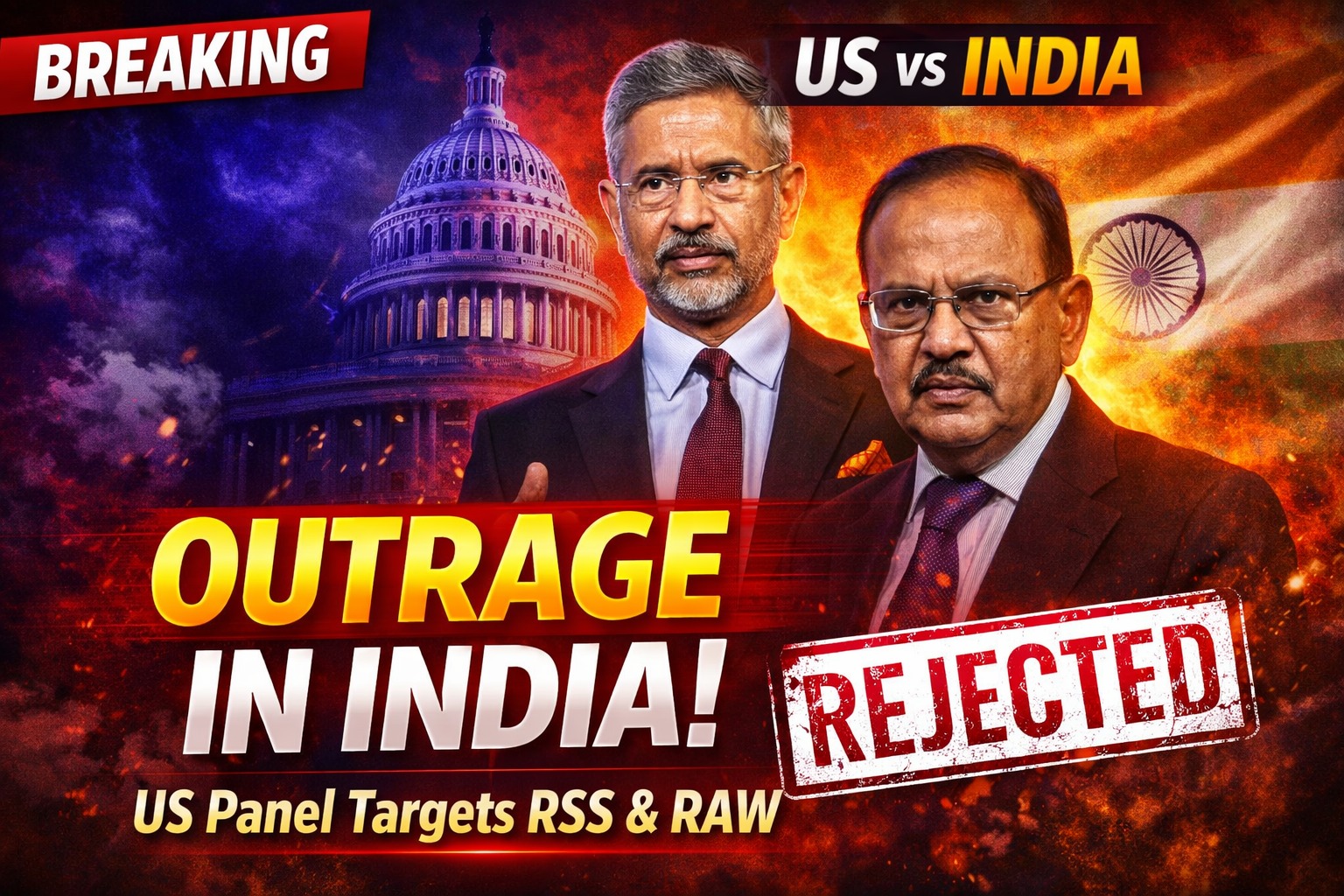
US Panel Recommends Action Against RSS and RAW, India Rejects Report as Biased and Misleading
A fresh diplomatic controversy has emerged after a United States government-backed commission recommended sanctions against prominent Indian organizations, including the Rashtriya Swayamsevak Sangh and India’s external intelligence agency, Research and Analysis Wing. The report has also suggested designating India as a “country of particular concern” over alleged violations of religious freedom.
The recommendations, issued by the United States Commission on International Religious Freedom (USCIRF), have drawn strong criticism in India, with officials reiterating that such assessments are “biased” and “politically motivated.”
What the USCIRF Report Says
In its latest annual report, the USCIRF raised concerns about what it described as a decline in religious freedom conditions in India. The commission accused the government of policies and actions that allegedly target religious minorities and restrict their freedoms.
Among its key recommendations, the USCIRF called for:
- Targeted sanctions against organizations such as the RSS
- Action against India’s intelligence agency RAW
- Linking US arms sales and trade policies to religious freedom conditions in India
- Officially designating India as a “country of particular concern”
The commission also urged the US government to invoke provisions under the Arms Export Control Act to potentially halt arms transfers to India.
Understanding USCIRF’s Role
The USCIRF was established in 1998 through an act of the US Congress. Its primary mandate is to monitor the global status of religious freedom and provide policy recommendations to the US administration, including the President, the Secretary of State, and lawmakers.
Although the commission describes itself as independent, its members are appointed by the US President and senior political leaders in Congress. This has often led to debates about its objectivity, especially when its findings intersect with sensitive geopolitical issues.
Allegations Highlighted in the Report
The report makes several claims regarding developments within India. It alleges that certain state governments have introduced or strengthened anti-conversion laws, increasing penalties and enforcement mechanisms.
Additionally, the USCIRF has accused Indian authorities of:
- Detaining and deporting individuals, including religious refugees
- Allowing or failing to prevent vigilante violence against minority communities
- Supporting or tolerating actions that affect places of worship
The report also references incidents of communal unrest in states such as Maharashtra, Odisha, and Uttar Pradesh. It attributes some of these tensions to groups associated with the RSS, including the Vishwa Hindu Parishad.
Furthermore, the commission has raised concerns about certain legislative measures, including:
- The Waqf Amendment Act, which deals with the management of Islamic charitable properties
- The Uttarakhand State Authority for Minority Education Act, related to minority education governance
According to the USCIRF, these developments collectively indicate a pattern of policies that could adversely impact religious minorities.
India’s Response and Position
While India’s Ministry of External Affairs has not issued a fresh response to the latest report, it has consistently rejected similar findings in the past.
Indian officials have described USCIRF reports as selective and lacking an understanding of the country’s social and cultural complexities. In previous statements, the ministry has emphasized that such reports often rely on isolated incidents rather than presenting a comprehensive view.
In 2025, the ministry strongly criticized the commission, stating that its assessments reflect a “deliberate agenda” rather than genuine concern for religious freedom.
India’s Argument: A Pluralistic Society
India has repeatedly highlighted its identity as a diverse and pluralistic nation. Home to more than 1.4 billion people, the country encompasses a wide range of religions, languages, and cultural traditions.
Government officials argue that this diversity is a testament to India’s democratic values and long-standing tradition of coexistence. They maintain that the country’s constitutional framework guarantees freedom of religion to all citizens.
In response to past USCIRF reports, the government has asserted that attempts to portray India in a negative light undermine its global reputation as a tolerant and democratic society.
Diplomatic Tensions and Past Disputes
The differences between India and the USCIRF are not new. Over the years, India has consistently pushed back against the commission’s findings.
In several instances, India has denied visas to USCIRF delegations seeking to visit the country. The government has also rejected the commission’s criticisms of policies such as the Citizenship (Amendment) Act.
These disagreements highlight broader tensions over how religious freedom is assessed and interpreted in different political and cultural contexts.
Implications for India-US Relations
The latest recommendations come at a time when India and the United States share strong strategic and economic ties. Cooperation between the two countries spans defense, technology, trade, and regional security.
While USCIRF’s recommendations do not automatically translate into US government policy, they can influence discussions within Washington. Any move to link arms sales or trade agreements to religious freedom concerns could complicate bilateral relations.
However, analysts note that such measures are unlikely to be implemented without careful consideration, given the importance of India as a strategic partner in the Indo-Pacific region.
Debate Over Objectivity and Political Influence
Critics of the USCIRF argue that its reports sometimes reflect political biases and fail to account for the complexities of domestic issues in other countries.
They point out that the commission’s reliance on selected incidents and external reports may not always provide a balanced perspective. Supporters, on the other hand, contend that the USCIRF plays an important role in highlighting human rights concerns globally.
This ongoing debate underscores the challenges of assessing sensitive issues like religious freedom in a global context.
The Broader Context of Religious Freedom
The issue of religious freedom remains a key component of international human rights discourse. Governments, organizations, and advocacy groups often have differing interpretations of what constitutes a violation.
In India’s case, the debate is further complicated by its size, diversity, and complex socio-political landscape. Incidents at the local level can sometimes be amplified in international discussions, leading to differing narratives.
What Lies Ahead
As of now, there has been no indication that the US government will act on the USCIRF’s recommendations. However, the report is likely to remain a point of discussion in diplomatic engagements between the two countries.
India is expected to continue defending its position and rejecting what it sees as external interference in its internal affairs. At the same time, the issue may prompt further dialogue on human rights and governance standards.
Summary
The US Commission on International Religious Freedom has recommended sanctions against organizations like the RSS and RAW and suggested designating India as a “country of particular concern.” The report alleges declining religious freedom and calls for linking US arms sales to these concerns. India has strongly rejected such assessments in the past, calling them biased and politically motivated, while emphasizing its identity as a diverse and democratic nation with constitutional protections for all religions.
Disclaimer:
This article is based on publicly available information, official statements, and media reports available at the time of publication. The content is intended solely for informational and journalistic purposes.
While efforts have been made to ensure accuracy, NoCap Times does not independently verify all claims, statements, or allegations made by individuals, witnesses, or investigative sources mentioned in the report.
As investigations are ongoing, certain details may change as authorities release further updates. Readers are advised to treat the information as part of a developing news story. NoCap Times shall not be held responsible for any inaccuracies, omissions, or changes that may arise as new verified information becomes available.