
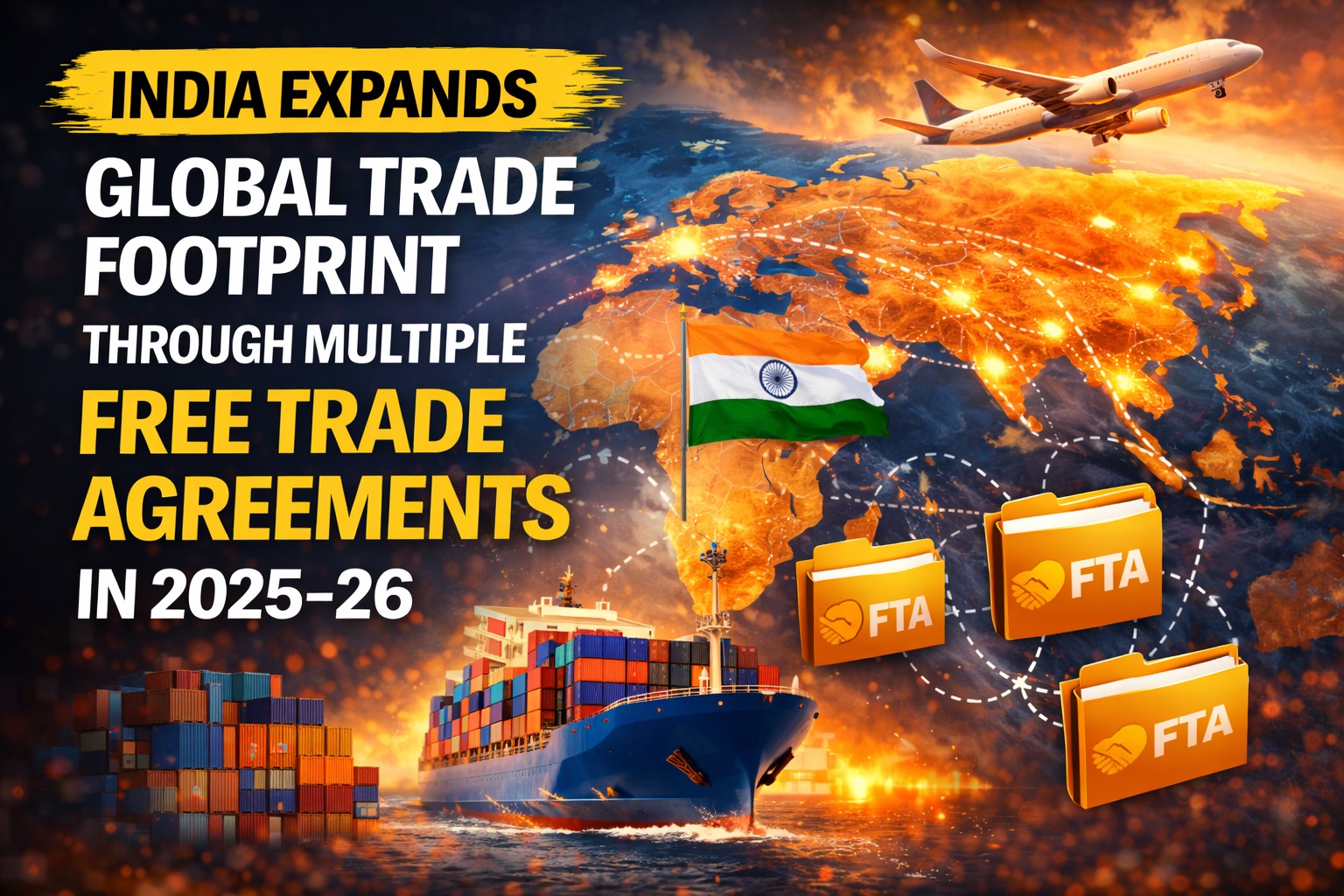
India Expands Global Trade Footprint Through Multiple Free Trade Agreements in 2025–26
India has significantly expanded its global trade partnerships through a series of Free Trade Agreements (FTAs) signed and implemented over the past few years, including several major deals during 2025–26. These agreements aim to improve market access, boost exports, and strengthen economic ties with key partners across the world. The government states that India now has nine FTAs covering 38 countries, supporting opportunities for farmers, MSMEs, professionals, and emerging sectors such as digital services and traditional wellness industries.
India Strengthens Global Trade Network
India has accelerated its efforts to expand international trade partnerships through a new generation of Free Trade Agreements (FTAs) aimed at improving market access and strengthening economic cooperation.
According to the Government of India, the country currently has nine major FTAs covering 38 nations, reflecting a broader strategy to deepen its integration with the global economy.
These agreements are designed to support export growth, encourage foreign investment, and open new opportunities for businesses across sectors.
Key Trade Agreements Signed in Recent Years
India’s recent trade expansion began with the India–Mauritius Comprehensive Economic Cooperation and Partnership Agreement in 2021.
This was followed by several significant agreements, including:
- India–UAE Comprehensive Economic Partnership Agreement, which came into force in May 2022
- India–Australia Economic Cooperation and Trade Agreement, implemented in December 2022
- India–EFTA Trade and Economic Partnership Agreement, signed in March 2024 and effective from October 1, 2025
During 2025, India also concluded new agreements such as:
- India–UK Comprehensive Economic and Trade Agreement signed in July 2025
- India–Oman Comprehensive Economic Partnership Agreement signed in December 2025
Further expanding its trade engagement, India announced:
- A Free Trade Agreement with New Zealand in December 2025
- An FTA with the European Union in January 2026
In addition, India and the United States released a framework for an interim bilateral trade agreement in February 2026.
Opportunities for Multiple Economic Sectors
The government believes these agreements will open new growth opportunities across several sectors of the Indian economy.
Agriculture and farming communities are expected to gain improved access to high-value markets in developed countries.
Meanwhile, entrepreneurs and small businesses, particularly women-led MSMEs, could expand exports in industries such as:
- Garments and textiles
- Leather products
- Handicrafts and traditional goods
Greater Mobility for Indian Professionals
Another key benefit of the trade agreements is improved mobility for skilled professionals.
Several FTAs include provisions that allow easier movement of workers and professionals such as:
- IT specialists
- Students pursuing international education
- Chefs and hospitality professionals
- Yoga instructors and wellness experts
These provisions may include post-study work visas, mobility pathways, and social security exemptions.
Boost for Emerging Sectors
The agreements are also expected to support global expansion of emerging Indian sectors.
Industries that could gain stronger international visibility include:
- Digital and IT-enabled services
- Organic agricultural products
- Traditional healthcare and wellness systems under Ministry of AYUSH
These sectors are increasingly becoming part of India’s broader export strategy.
Balancing Global Access With Domestic Protection
According to government officials, the trade agreements have been negotiated with a balanced approach.
While aiming to improve global competitiveness and export growth, the deals also include safeguards to protect sensitive domestic sectors such as:
- Dairy
- Agriculture
- Local manufacturing industries
This strategy aims to ensure that India benefits from global trade expansion without undermining key domestic industries.
Summary
India has expanded its global trade network through a series of Free Trade Agreements covering 38 countries. Key agreements signed or implemented between 2021 and 2026 include deals with the UAE, Australia, EFTA nations, the United Kingdom, Oman, New Zealand, and the European Union, along with a proposed interim trade framework with the United States. These agreements are expected to boost exports, improve market access for farmers and MSMEs, increase mobility for Indian professionals, and strengthen emerging sectors such as digital services and traditional wellness industries.
Disclaimer
The information in this article is based on publicly available government statements and announcements related to India’s trade agreements. The impact and implementation of specific provisions may evolve as the agreements are operationalised and further policy updates are issued. The content is intended for informational purposes only. The publication does not independently verify third-party claims or assertions mentioned in developments.