
India and Brazil Raise Trade Ambitions to $30 Billion by 2030; Leaders Review Impact of US Tariff Ruling
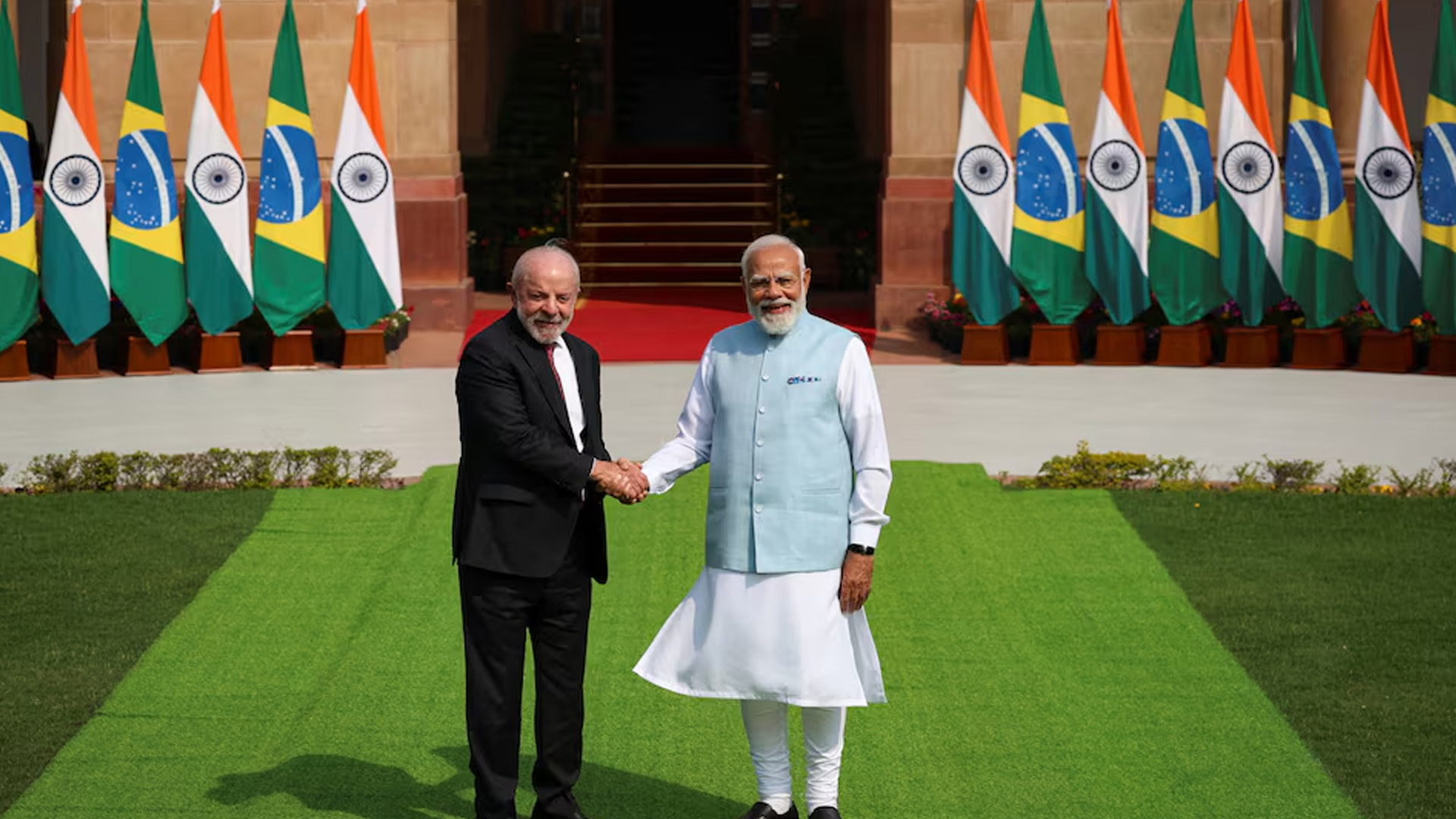
India and Brazil have significantly elevated their economic partnership, setting a new bilateral trade target of USD 30 billion annually by 2030. The decision came after wide-ranging discussions between Prime Minister Narendra Modi and Brazilian President Luiz Inacio Lula da Silva during Lula’s five-day visit to India.
The two leaders also reviewed the global trade landscape, including the recent ruling by the Supreme Court of the United States striking down former President Donald Trump’s reciprocal tariffs. Both sides agreed to adopt a “wait and watch” approach while assessing the implications of Washington’s next steps.
Nine Agreements Signed, Focus on Critical Minerals
Following delegation-level talks, India and Brazil signed nine agreements covering sectors such as critical minerals, rare earth elements, digital partnership, mining, MSMEs, healthcare, and traditional knowledge systems.
A key highlight was a pact on cooperation in rare earths and critical minerals—an area considered crucial for building resilient supply chains in high-tech and renewable energy industries. The two countries also issued a joint declaration on a futuristic digital partnership, including plans to establish a Centre of Excellence for Digital Public Infrastructure in Brazil.
The leaders emphasized collaboration in emerging technologies such as artificial intelligence, supercomputing, semiconductors, and blockchain.
Trade Goals Revised Upward
While the two nations had earlier aimed for USD 20 billion in trade by 2030, both leaders agreed to scale up ambitions and double current trade volumes to reach USD 30 billion by the end of the decade.
In 2024–25, bilateral trade stood at USD 12 billion, with Indian exports totaling USD 6.77 billion and imports from Brazil at USD 5.43 billion. Brazil remains India’s largest trading partner in Latin America.
Prime Minister Modi described trade as “a reflection of trust,” underscoring the importance of deepening economic engagement amid global uncertainty.
Defence and Aerospace Cooperation
Defence collaboration also featured prominently in discussions. The two sides explored maintenance cooperation for their French-origin Scorpene submarines under a tripartite arrangement involving Mazagon Dock Shipbuilders Limited and the Indian and Brazilian navies.
Brazilian aerospace giant Embraer’s proposal to establish an assembly line in India for its E175 regional jet was also discussed. India encouraged the setting up of a maintenance, repair and overhaul (MRO) facility to support aviation cooperation.
Shared Voice of the Global South
Both leaders highlighted the importance of India-Brazil coordination in representing the interests of the Global South. They reaffirmed support for reforming global institutions, particularly the United Nations Security Council, arguing that it must better reflect contemporary geopolitical realities.
President Lula described the India-Brazil dialogue as an engagement between a “digital superpower” and a “renewable energy superpower,” stressing the need for multilateralism, peace, and sustainable development in a turbulent global environment.
Prime Minister Modi reiterated that terrorism and its supporters are “enemies of humanity,” while both sides called for comprehensive international cooperation to combat violent extremism, including cross-border terrorism.
Energy and Climate Partnership
Energy cooperation remains a cornerstone of the relationship. In addition to hydrocarbons, the two countries are expanding collaboration in renewable energy, ethanol blending, and sustainable aviation fuel. Brazil’s participation in the India-backed Global Biofuel Alliance was cited as a sign of shared commitment to green growth.
Brazil also proposed co-chairing the India-led Coalition for Disaster Resilient Infrastructure (CDRI), an initiative aimed at strengthening climate-resilient infrastructure worldwide.
Expanding Trade Architecture
The leaders also discussed expanding the India-Mercosur Preferential Trade Agreement (PTA) to unlock new economic opportunities. As geopolitical fragmentation intensifies, both sides see deeper strategic alignment as a stabilizing force in global affairs.
With enhanced cooperation spanning trade, defence, technology, and energy, India and Brazil appear poised to elevate their partnership into a more comprehensive strategic framework.
Summary
India and Brazil have raised their bilateral trade target to USD 30 billion by 2030 and signed nine agreements, including a major pact on critical minerals and rare earth cooperation. Prime Minister Narendra Modi and President Luiz Inacio Lula da Silva also discussed the implications of the US Supreme Court striking down Trump’s reciprocal tariffs, agreeing to monitor developments. The talks covered defence ties, digital partnership, renewable energy, UN reforms, and expanded Global South collaboration, signaling a strengthened strategic relationship amid global uncertainty.