

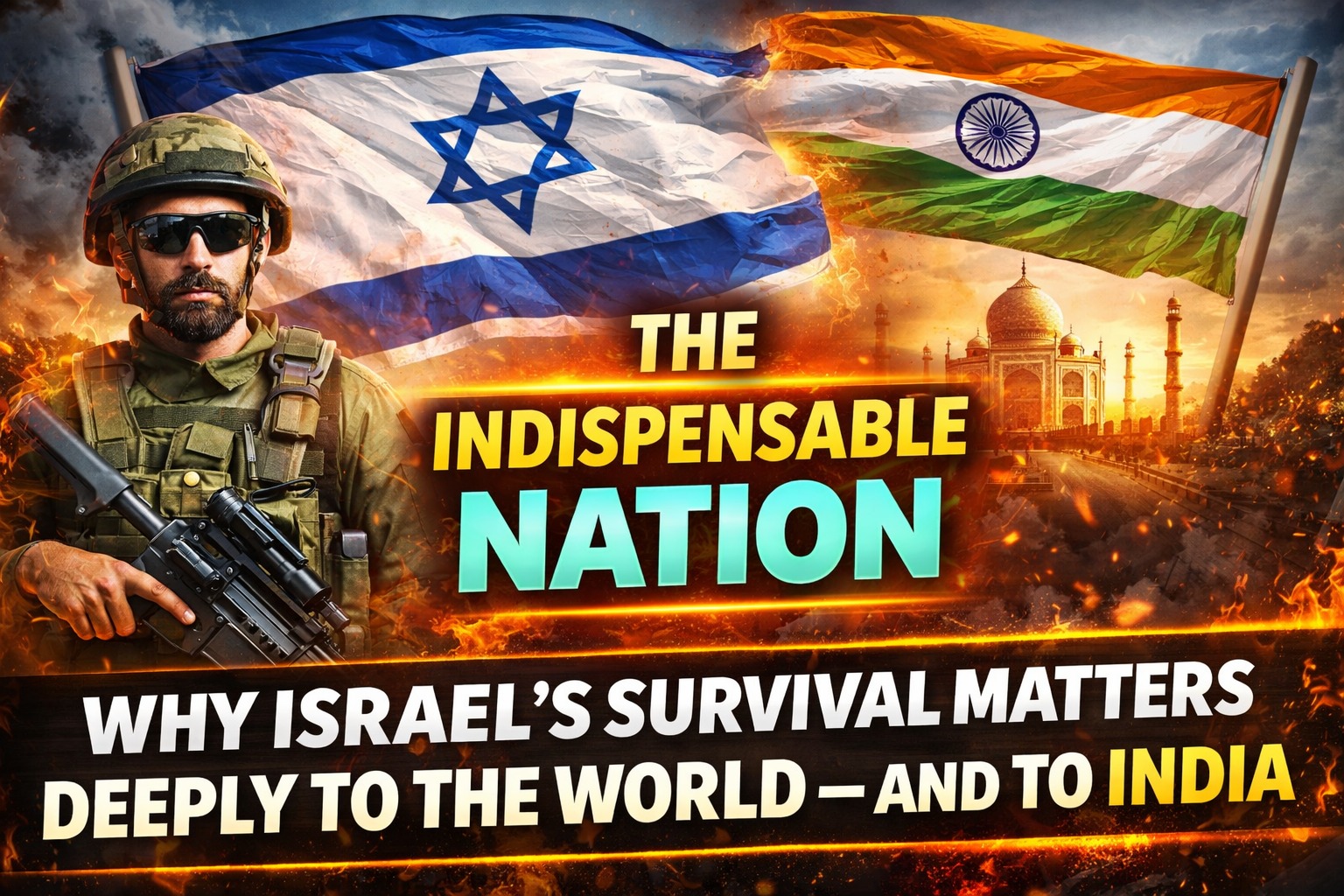
The Indispensable Nation: Why Israel’s Survival Matters Deeply to the World — and to India
In an era of rapid geopolitical shifts, few nations embody resilience and strategic value quite like Israel. A country roughly the size of Haryana — about 20,770 to 22,072 square kilometres depending on definitions — it sits at the volatile crossroads of Europe, Asia, and Africa. Bordered by Lebanon to the north, Syria to the northeast, Jordan to the east, Egypt to the southwest, and the Mediterranean to the west, Israel is barely nine miles wide at its narrowest point near Netanya. By conventional military logic, a nation this compact, surrounded by larger adversaries who have repeatedly vowed its destruction, should not have endured. Yet it has — not merely survived, but repeatedly prevailed, innovated, and contributed disproportionately to global progress.
This is no accident of history. Israel’s story is rooted in an ancient ethos of liberation, moral law, and determined self-defence that continues to shape its character today. As the ongoing West Asia conflict enters a delicate phase — with oil prices slipping below $100 per barrel on hopes of a US-brokered five-day energy truce and 15-point ceasefire proposal — the world is reminded once again why a strong, secure Israel remains indispensable.
The Moral and Legal Foundations: From Moses to Modern Democracy
The Jewish narrative begins not with conquest but with liberation. Moses, raised in Pharaoh’s court, chose solidarity with the enslaved over personal privilege. The Exodus and the giving of the Ten Commandments at Sinai introduced the revolutionary idea that law — moral, transcendent, and binding on all, including rulers — underpins society. This “constitutional moment” influenced later democratic thought, from Montesquieu to the American Founders. The Liberty Bell in Philadelphia echoes Leviticus: “Proclaim liberty throughout all the land unto all the inhabitants thereof.”
This memory of suffering — the Torah recalls slavery in Egypt over thirty times — forged an ethical imperative against oppression. It is the same imperative that drives Israel’s commitment to “Tohar HaNeshek” (purity of arms), an IDF doctrine insisting force be used only when necessary and proportionately, even in existential threats. No other military in the region operates under comparable self-imposed constraints.
David’s Legacy: Asymmetric Warfare and the Soul of a Warrior-Poet
King David, the shepherd boy who felled Goliath with a sling and five smooth stones, embodies Israel’s military DNA. He refused ill-fitting armour and fought on his own terms — speed, ingenuity, and refusal to accept the enemy’s rules of engagement. This principle echoes through Israeli doctrine: the 1967 Six-Day War pre-emptive airstrikes that destroyed Egypt’s air force on the ground; the development of Iron Dome against rocket barrages; precision operations against Hezbollah and Iranian proxies; and reported cyber strikes on nuclear infrastructure.
David was also a poet whose Psalms capture raw human vulnerability — fear, repentance, faith. Jerusalem, the city he made his capital, remains the spiritual and emotional heart of Jewish identity. For two millennia, Jews ended Passover seders with “Next year in Jerusalem.” In 1967, paratroopers reaching the Western Wall fulfilled that longing in one of history’s most profound moments of return.
From Haganah to the IDF: Improvisation in the Face of Annihilation
The modern chapter began with the Haganah (“defence”), a clandestine force born from necessity. In the 1930s–40s, as the British White Paper curtailed Jewish immigration precisely when Holocaust survivors desperately needed refuge, the Haganah organised illegal Aliyah Bet voyages and smuggled weapons. The 1947 SS Exodus scandal helped sway global opinion toward partition.
On May 14, 1948, Israel declared independence. Hours later, armies from Egypt, Jordan, Syria, Lebanon, and Iraq invaded. Outnumbered and outgunned, the newly formed IDF — evolved from the Haganah — prevailed. In 1973’s Yom Kippur War, Israel reversed catastrophic early losses and advanced toward Cairo. Recent operations have neutralised senior Hezbollah commanders with precision and disrupted Iranian supply lines.
This culture of flat command, initiative, and improvisation has produced battlefield innovations shared with allies: Iron Dome (90%+ intercept rate), drones, cyber tools, and battlefield medicine.
The Persistent Shadow: Antisemitism’s Mutation
Tragically, Israel’s strength has not granted safety to Jews worldwide. Antisemitic incidents have surged globally. Reports document vandalism of cemeteries in France, the US, Germany, and the UK; firebombings of synagogues; and hostile campus environments where Jewish students hide symbols. The 1994 AMIA bombing in Argentina killed 85; the 2018 Pittsburgh synagogue attack claimed 11 lives — the deadliest on American soil.
Antisemitism mutates: far-right conspiracy theories about control of finance and media; left-wing blurring of policy critique with collective hatred of Jews; and state-sponsored rhetoric in parts of the Islamic world echoing Nazi-era tropes. Post-Holocaust vows of “never again” ring hollow when incidents spike despite — or because of — Israel’s existence.
The Strategic Imperative: Intelligence, Technology, and Regional Balance
In realpolitik terms, Israel is a force multiplier for open societies. Its intelligence services (Mossad, Shin Bet, Unit 8200) provide unparalleled insights into Iranian nuclear ambitions, Hezbollah networks, and terrorist plots — leads that have foiled attacks on Western targets. Shared technology includes missile defence now integrated into NATO frameworks, drones, cyber capabilities, and counterterrorism doctrine.
A strong Israel deters Iranian expansion. The Abraham Accords — normalising ties with the UAE, Bahrain, Morocco, Sudan, and later expansions — show Sunni Arab states viewing Israel as a bulwark against Persian hegemony. Without it, a Hezbollah-Hamas-Iran arc could dominate from Tehran to the Mediterranean, threatening moderate voices and Western interests.
Israel remains the Middle East’s sole liberal democracy: Arab citizens in parliament, a fiercely independent judiciary and press, vibrant debate. In a region of theocracies and authoritarianism, it proves pluralism and innovation can flourish.
The Moral Debt: A Monument to Civilisational Failure
The world failed Jews during the Holocaust — six million murdered for existing. Britain restricted immigration; the US declined to bomb Auschwitz rail lines. Israel emerged as the survivors’ answer: never again dependent on others’ goodwill. Allowing its erosion — militarily, economically, or through delegitimisation — would betray that debt and signal to every vulnerable people that sovereignty is a luxury for the strong alone.
Future Horizons: Innovation as Survival
Looking to 2035–2050, Israel’s edge sharpens. Its “Silicon Wadi” leads in startups per capita. Desalination turns desert into water exporter; agricultural tech combats climate-driven food insecurity; cybersecurity protects global infrastructure. Battle-tested AI and biotech give allies structural advantages.
Why India Stands with Israel
For India, partnership with Israel is rooted in shared realities, not rhetoric. Both nations face existential threats from actors seeking not compromise but elimination — terrorism, proxies, nuclear shadows. India’s experience with cross-border challenges mirrors Israel’s.
Cooperation delivers results: defence systems strengthening Indian preparedness; joint tech in agriculture, water, cyber; intelligence sharing. Recent engagements, including high-level visits and MoUs on defence and emerging technologies, reflect deepening ties. Prime Minister Modi’s outreach underscores strategic autonomy — choices based on mutual benefit and experience.
Support does not ignore humanitarian suffering anywhere. But it rejects false equivalences that ignore who initiates violence or the necessity of deterrence. A secure Israel reinforces the principle that nations facing organised threats have the right to defend themselves decisively.
In today’s West Asia crisis — with oil volatility, Hormuz disruptions, and fragile truce hopes — Israel’s role as a stabilising innovator and democratic anchor is clearer than ever. The world, and India especially, cannot afford to see it weakened. History’s lesson is consistent: threats do not yield to ambiguity; survival demands clarity, strength, and alliances grounded in shared values and hard-won realism.
Israel is not perfect — no nation is. Yet its improbable journey from ancient liberation to modern powerhouse offers a template of resilience the civilised world would be unwise to abandon. Its continued strength is not merely Israel’s interest; it is a shared global necessity.
Disclaimer
This article is based on official statements and publicly available information at the time of publication. The global energy situation is dynamic and may change with evolving geopolitical developments.
The content is intended for informational purposes only and should not be considered financial or policy advice. Readers are encouraged to refer to official sources for the latest updates.
NoCap Times does not independently verify all claims and shall not be held responsible for any inaccuracies or omissions.