

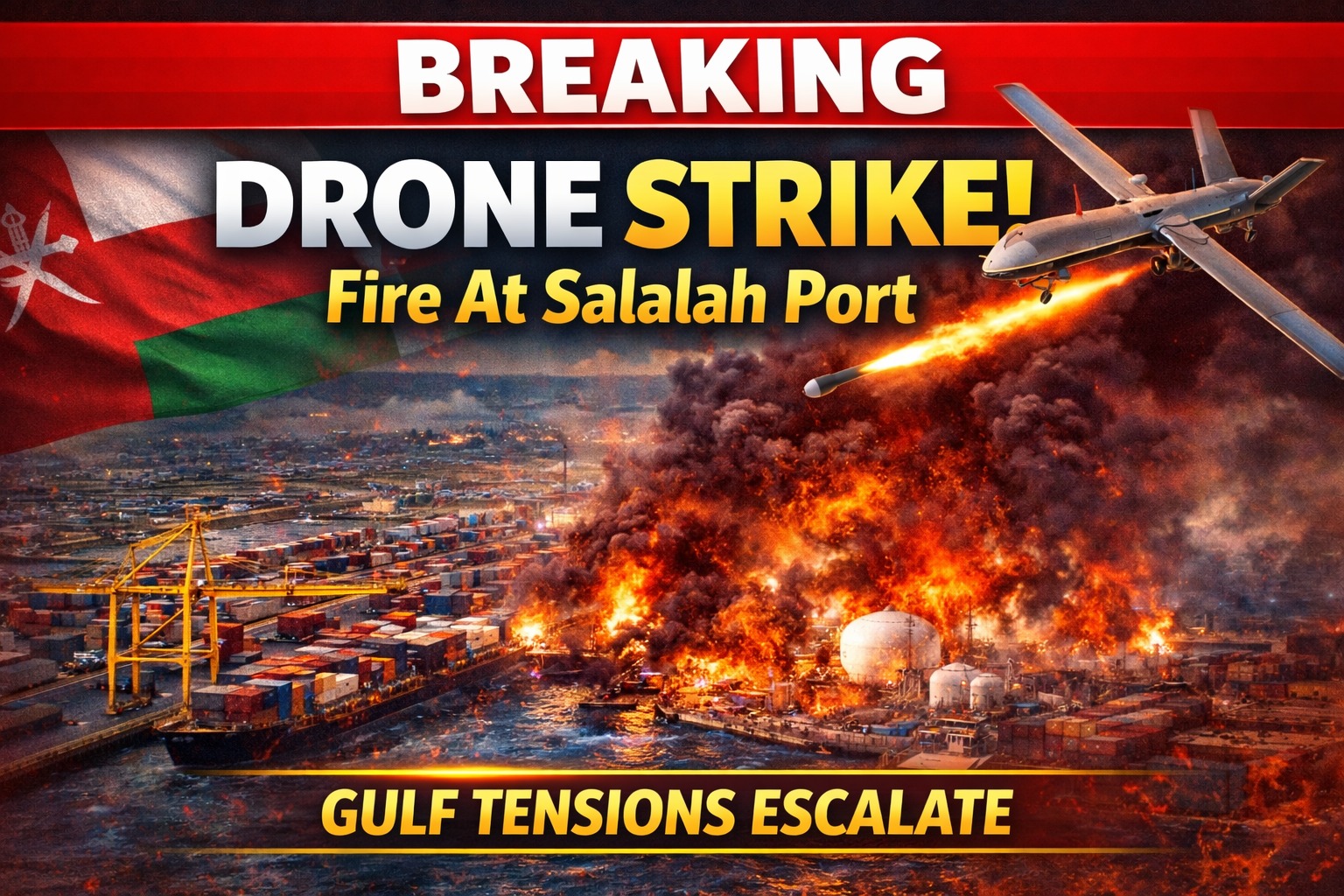
Drone Strike Triggers Massive Fire at Oman’s Salalah Port Amid Escalating Gulf Tensions
A major fire erupted at the strategic Port of Salalah after suspected drone strikes hit oil storage facilities on March 12, sending thick plumes of smoke into the sky and forcing the suspension of operations at parts of the port.
Videos circulating online showed flames and dense black smoke rising from the facility as emergency teams rushed to contain the blaze. The incident marks another escalation in the growing regional conflict linked to the ongoing tensions between Iran, United States, and Israel.
Drone Attack Targets Oil Infrastructure
According to maritime security firm Ambrey, the drone strikes specifically targeted port infrastructure at the Salalah facility.
The firm confirmed that while oil storage facilities were hit, no merchant vessels were damaged in the attack.
However, the impact on the port’s infrastructure forced authorities to halt operations at both container terminals and general cargo terminals.
Shipping and logistics companies began rerouting vessels or delaying operations as authorities assessed the situation.
Salalah Port Suspends Key Operations
The Port of Salalah is one of the most important logistics and transshipment hubs in the Middle East, serving international shipping routes that connect Asia, Europe, and Africa.
Following the drone strike, port authorities suspended key activities at the facility.
However, reports indicate that other ports across Oman continue to operate normally, preventing major disruptions to the country’s maritime trade network.
The operational pause at Salalah was described as a precautionary measure while authorities investigate the damage and ensure safety at the port.
Oman Moves Oil Tankers Out of Key Export Terminal
In response to the attack, Oman reportedly moved vessels away from its primary oil export hub, the Mina Al Fahal terminal.
The precautionary move was intended to safeguard tankers and energy shipments from potential follow-up attacks.
The terminal plays a vital role in the country’s energy exports.
According to data intelligence company Kpler, approximately one million barrels of Omani crude oil are exported daily from Mina Al Fahal.
Any disruption at this facility could therefore have significant implications for regional oil supply chains.
Oman Condemns Attack on Its Territory
Following the incident, Haitham bin Tariq held a conversation with Masoud Pezeshkian regarding the attack.
During the discussion, the Omani leader condemned the strikes on Omani territory and expressed concern over the growing instability in the region.
The Sultan reaffirmed that Oman remains neutral in the ongoing conflict but emphasized that the country will take all necessary steps to protect its sovereignty, security, and economic infrastructure.
Diplomatic Tensions Rise in the Region
The drone strikes come shortly after a series of diplomatic developments involving Iran and Oman.
Earlier this month, Haitham bin Tariq reportedly congratulated Mojtaba Khamenei on his appointment as Iran’s new supreme leader, according to reports citing the official Omani news agency.
The latest attack has added new complexity to the regional situation and could further strain diplomatic ties.
Oil Markets React to Rising Conflict
The wider conflict in the Middle East has already caused major disruptions to global energy markets.
In response to rising oil prices, the United States has announced plans to release 172 million barrels of oil from strategic reserves as part of an international effort to stabilize global energy markets.
Global oil consumption currently stands at slightly above 100 million barrels per day, and analysts estimate that Gulf producers have already reduced supply by roughly 6 percent due to the ongoing conflict.
Any additional disruptions could intensify volatility in global energy markets.
Strait of Hormuz Crisis Drives Energy Concerns
Another factor adding pressure to oil markets is the near closure of the critical Strait of Hormuz.
This narrow waterway connects the Persian Gulf to the Arabian Sea and is responsible for transporting roughly 20 percent of the world’s seaborne oil supply.
Security threats, attacks on vessels, and military activity have significantly reduced shipping traffic through the strait.
As a result, prices of crude oil, natural gas, and refined fuels such as diesel have surged, raising fears of a potential global inflation shock driven by energy costs.
Oman’s Mediation Efforts Collapse
Before the escalation of hostilities, Oman had attempted to act as a mediator between Iran and the United States.
The country has historically maintained diplomatic ties with both sides and has frequently served as a neutral facilitator in regional negotiations.
However, sources indicate that these mediation efforts have effectively collapsed as the conflict intensified over the past eleven days.
Commercial Ships Also Targeted Near Hormuz
Separate reports from the United Kingdom Maritime Trade Operations (UKMTO) indicate that several commercial ships operating near the Strait of Hormuz have also come under attack.
According to the agency, three commercial vessels were struck by unidentified projectiles in the region, further highlighting the growing dangers for maritime traffic in Gulf waters.
Shipping companies and global trade organizations are now closely monitoring developments as the risk to commercial navigation continues to rise.
Summary
- A drone strike caused a massive fire at the Port of Salalah.
- Oil storage infrastructure was targeted, though no merchant vessels were damaged.
- Oman temporarily suspended operations at Salalah’s cargo terminals.
- Authorities moved vessels away from the Mina Al Fahal oil export terminal as a precaution.
- Haitham bin Tariq condemned the attack during talks with Masoud Pezeshkian.
- The incident comes amid escalating tensions between Iran, United States, and Israel.
- Attacks on ships near the Strait of Hormuz are raising concerns about global oil supply disruptions.
Disclaimer:
This article is based on publicly available information, media reports, and statements from government officials and maritime security agencies. The content is intended solely for informational and journalistic purposes.
Due to the rapidly evolving nature of geopolitical conflicts and military developments in the Middle East, some information may change as new details emerge. NoCap Times does not independently verify all third-party claims, battlefield reports, or statements made by external organizations and sources.
Readers are advised to consider the information as part of an ongoing and developing situation. NoCap Times shall not be held responsible for inaccuracies, omissions, or updates that may arise as further official confirmations become available.