


Fast Breeder Reactor: India’s Breakthrough That Could Redefine Global Nuclear Energy
India achieves a historic milestone in Fast Breeder Reactor technology with PFBR at Kalpakkam, unlocking energy independence and thorium potential.
Fast Breeder Reactor Breakthrough: India Joins Elite Global Nuclear Club
India has taken a giant leap in the field of nuclear energy with the successful achievement of criticality in its 500 MWe Prototype Fast Breeder Reactor (PFBR). Located at Kalpakkam, this development marks a historic moment not just for the country but for the global energy landscape.
On April 6, 2026, at precisely 8:25 PM, India entered an elite league of nations capable of operating a commercial-scale Fast Breeder Reactor. Until now, only Russia had achieved this level of technological sophistication. This milestone signals a shift in how nations may approach long-term energy security and sustainability.
Unlike conventional nuclear reactors, this advancement is not merely about generating electricity. It is about creating a self-sustaining energy ecosystem—one that produces more fuel than it consumes.
What is a Fast Breeder Reactor and Why It Matters
A Fast Breeder Reactor (FBR) is a special type of nuclear reactor that operates on a fundamentally different principle compared to traditional reactors. Instead of simply consuming nuclear fuel, it generates additional fuel during operation.
In standard nuclear reactors, Uranium-235 is used as fuel. However, this isotope is scarce, especially in India. Once used, the fuel becomes waste. This is where Fast Breeder Reactor technology changes the game.
The PFBR at Kalpakkam uses Mixed Oxide (MOX) fuel, which combines uranium and plutonium. Surrounding its core is a blanket of Uranium-238. When the reactor operates, it produces high-energy neutrons—commonly referred to as “fast neutrons.”
These neutrons interact with Uranium-238 and convert it into Plutonium-239, which can be reused as fuel. In simple terms, the reactor “breeds” its own fuel while producing power.
This unique capability makes the Fast Breeder Reactor one of the most efficient energy systems ever developed.
Fast Breeder Reactor Technology: Extracting Maximum Energy
One of the most remarkable aspects of Fast Breeder Reactor technology is its ability to extract significantly more energy from nuclear fuel.
Traditional reactors utilize less than 1% of the total energy potential of uranium. In contrast, a Fast Breeder Reactor can utilize more than 60% of the same material.
This means:
- Less nuclear waste
- Higher efficiency
- Greater energy output from limited resources
Additionally, the PFBR uses liquid sodium as a coolant instead of water. Sodium has a much higher boiling point, allowing the reactor to operate at lower pressure. This enhances safety while maintaining high thermal efficiency.
Fast Breeder Reactor and the Closed Fuel Cycle
The concept of a “closed fuel cycle” is central to the importance of the Fast Breeder Reactor.
In a closed fuel cycle:
- Used fuel is reprocessed
- Valuable materials like plutonium are extracted
- These materials are reused as fuel
This minimizes waste and maximizes resource utilization.
India’s success in implementing this cycle places it far ahead of many developed nations that abandoned breeder reactor programs due to complexity and cost.
How Fast Breeder Reactors Differ from Conventional Nuclear Reactors in India
A Fast Breeder Reactor (FBR)—such as the Prototype Fast Breeder Reactor (PFBR) at Kalpakkam—operates on principles that are fundamentally different from the Pressurized Heavy Water Reactors (PHWRs) currently dominant in India. The key distinction lies in neutron behavior and the unique ability of FBRs to generate more fuel than they consume.
Key Technical Differences: Fast Breeder Reactor Vs Conventional Reactors in India
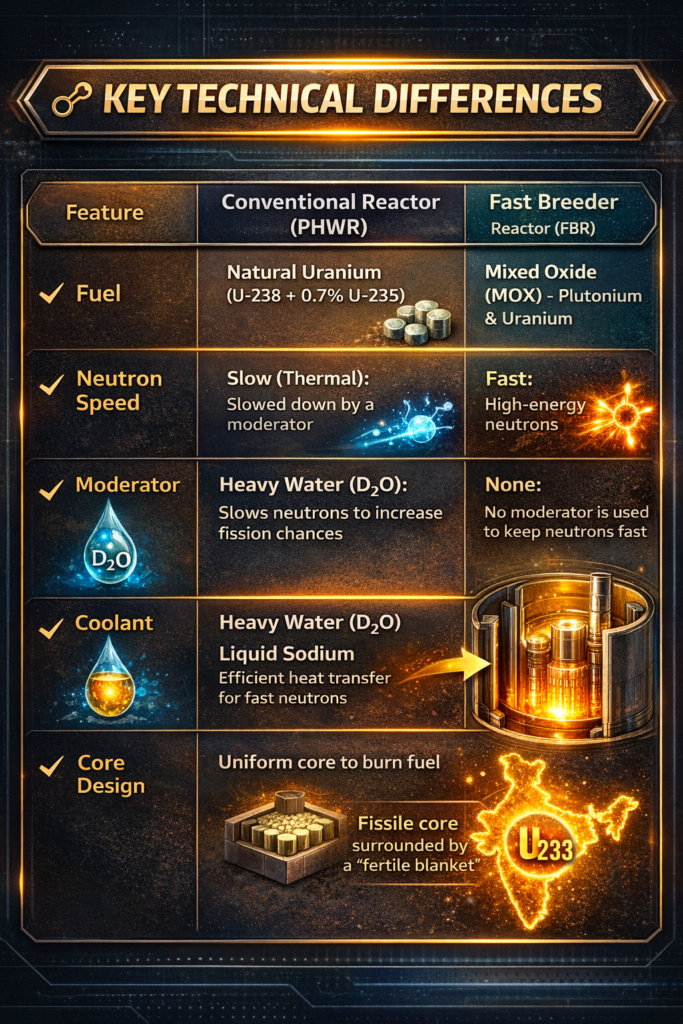
| Feature | Conventional Reactor (PHWR) | Fast Breeder Reactor (FBR) |
|---|---|---|
| Fuel | Natural uranium (mostly U-238 with a small fraction of U-235) | Mixed Oxide (MOX) fuel containing plutonium and uranium |
| Neutron Speed | Slow (thermal neutrons) | Fast (high-energy neutrons) |
| Moderator | Heavy water used to slow neutrons | No moderator used |
| Coolant | Heavy water | Liquid sodium |
| Core Design | Uniform structure for fuel consumption | Core surrounded by a fertile “blanket” |
A. Fuel Generation vs Fuel Consumption
Traditional reactors primarily consume nuclear fuel, producing energy while leaving behind radioactive waste.
In contrast, an FBR is designed to produce additional fuel during operation:
- The core contains fissile material such as plutonium-239.
- Surrounding it is a fertile blanket made of uranium-238 or thorium-232.
- Fast neutrons escaping the core interact with this blanket, converting it into new fissile material like plutonium-239 or uranium-233.
This process allows the reactor to effectively “breed” fuel.
B. Role of Neutrons in Fast Breeder Reactor
- PHWRs rely on slow-moving (thermal) neutrons. Heavy water is used to reduce neutron speed, improving the likelihood of fission in uranium-235.
- FBRs operate without slowing neutrons. Fast neutrons are essential because they efficiently convert abundant uranium-238 into usable fuel.
C. Cooling Mechanism of Fast Breeder Reactor
Conventional reactors use water as a coolant, which also acts as a neutron moderator.
FBRs, however, use liquid sodium because:
- It does not slow down neutrons
- It has a very high boiling point
- It allows operation at higher temperatures without requiring high pressure
This results in improved thermal efficiency.
India’s Strategic Move Towards Energy Independence
For decades, India has relied heavily on imported uranium to fuel its nuclear reactors. This dependency has posed both economic and geopolitical challenges.
However, the Fast Breeder Reactor changes this equation completely.
India possesses nearly 25% of the world’s thorium reserves. Thorium is a fertile material that can be converted into Uranium-233, a highly efficient nuclear fuel. But thorium cannot be used directly in conventional reactors.
This is where the Fast Breeder Reactor becomes crucial.
By mastering breeder technology, India creates a pathway to eventually utilize thorium on a large scale. This transition is part of India’s long-term three-stage nuclear program.
Fast Breeder Reactor as a Bridge to Thorium Power
The PFBR represents the second stage of India’s nuclear strategy. It acts as a bridge between uranium-based reactors and future thorium-based systems.
Here’s how:
- Uranium-238 is converted into plutonium in the breeder reactor
- Plutonium is used as fuel in advanced reactors
- Eventually, thorium is introduced to produce Uranium-233
This cycle can potentially provide India with energy security for hundreds of years.
Leadership Perspective on Fast Breeder Reactor Achievement
India’s leadership has recognized the significance of this milestone.
Narendra Modi described the achievement as a defining moment in the nation’s nuclear journey. He emphasized that the Fast Breeder Reactor is a key pillar of the Atmanirbhar Bharat initiative, aimed at making India self-reliant in critical sectors.
The project was executed under the guidance of the Department of Atomic Energy and implemented by BHAVINI, with contributions from over 200 Indian industries. This highlights the strength of indigenous innovation and engineering capabilities.
Dr. Ajit Kumar Mohanty, Secretary of the Department of Atomic Energy, also noted that this achievement demonstrates India’s ability to solve complex scientific challenges that many advanced nations have stepped away from.
Fast Breeder Reactor and Its Impact on India’s Energy Goals
The implications of this development are vast and far-reaching.
Key Highlights:
- Power Capacity: 500 MWe, capable of supplying electricity to around 5 lakh homes
- Continuous Power Supply: Provides stable baseload energy, unlike solar or wind
- Environmental Benefits: Supports India’s Net Zero 2070 target
- Fuel Efficiency: Drastically reduces dependence on fresh uranium
Unlike renewable sources, nuclear energy from Fast Breeder Reactors operates 24/7, ensuring a consistent power supply. This makes it an essential component of a balanced energy mix.
Fast Breeder Reactor vs Renewable Energy
While renewable energy sources like solar and wind are crucial, they are intermittent in nature. They depend on weather conditions and time of day.
Fast Breeder Reactors, on the other hand:
- Provide uninterrupted power
- Require less land
- Deliver higher energy density
This makes them indispensable for meeting growing energy demands in a developing economy like India.
What Happens Next for India’s Fast Breeder Reactor
After achieving criticality, the PFBR will undergo a series of low-power physics tests. These tests are essential to ensure stability and safety before full-scale operations begin.
Once these tests are completed, the reactor will be synchronized with India’s national power grid.
This will mark the beginning of commercial power generation from one of the most advanced nuclear systems in the world.
Global Significance of Fast Breeder Reactor Technology
India’s success sends a strong message to the global community.
Many Western nations paused or abandoned breeder reactor projects due to technical and economic challenges. India, however, has demonstrated that with persistence and innovation, these challenges can be overcome.
This achievement could reignite global interest in Fast Breeder Reactor technology as countries search for sustainable and reliable energy solutions.
Summary: Fast Breeder Reactor Ushers in a New Energy Era
India’s breakthrough in Fast Breeder Reactor technology is more than just a scientific achievement—it is a strategic transformation.
By successfully commissioning the PFBR:
- India has joined an exclusive group of technologically advanced nations
- It has unlocked the potential of a closed fuel cycle
- It has taken a decisive step towards utilizing its vast thorium reserves
- It has strengthened its path to energy independence
The Fast Breeder Reactor is not just a reactor—it is a vision for the future. A future where energy is abundant, sustainable, and self-reliant.
As the world grapples with energy challenges and climate change, India’s achievement may well become a blueprint for the next generation of nuclear power.
Disclaimer
This article is based on publicly available information, official statements, and media reports available at the time of publication. The content is intended for informational purposes only and should not be considered financial or policy advice. Readers are encouraged to refer to official sources for the latest updates.
While efforts have been made to ensure accuracy, the information presented may change as new developments emerge. Readers are advised to conduct their own research and consult financial advisors before making any investment decisions.
NoCap Times does not independently verify all claims or statements and shall not be held responsible for any inaccuracies or omissions.