
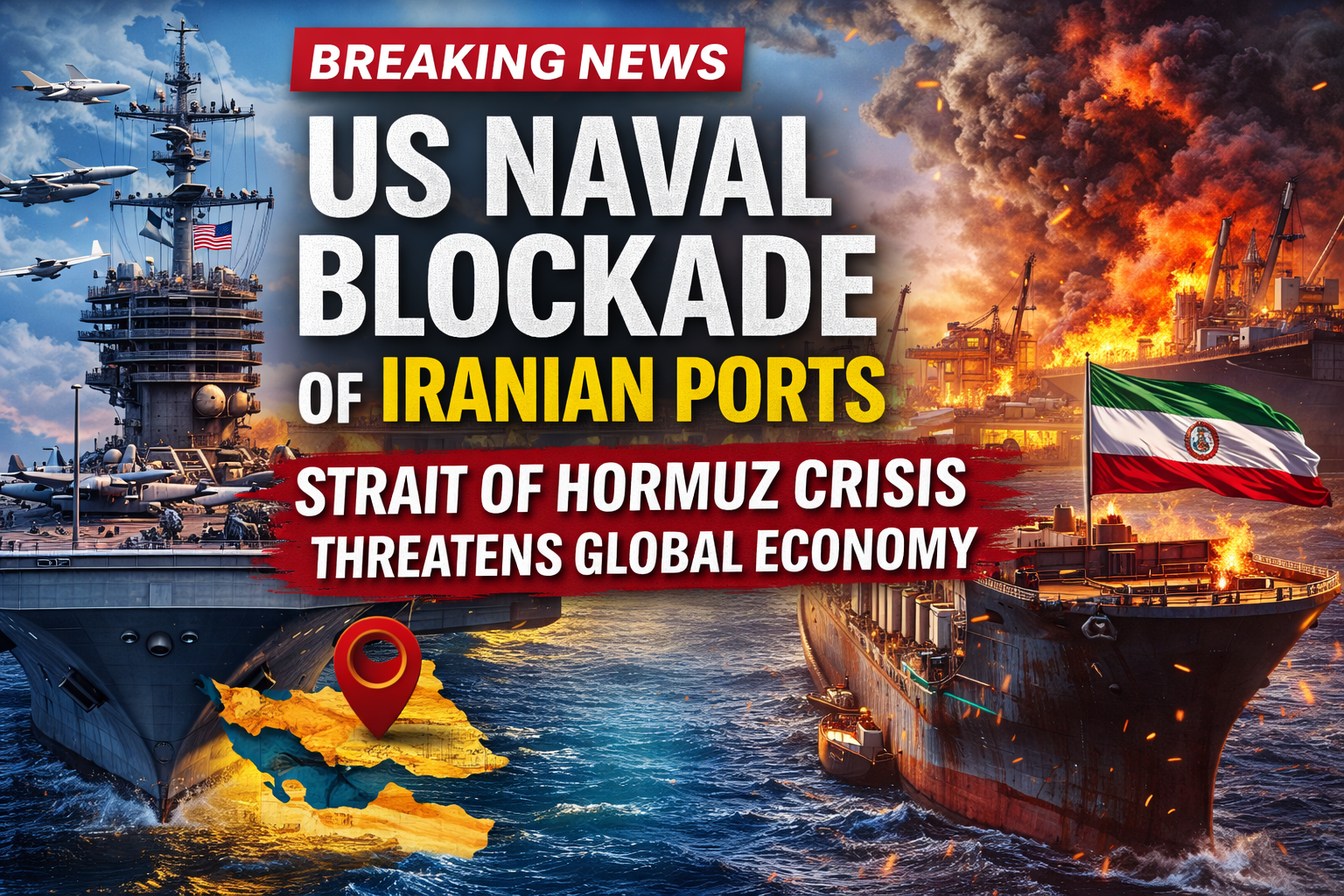
US Naval Blockade of Iranian Ports: Strait of Hormuz Crisis Threatens Global Economy
US Naval Blockade of Iranian Ports Begins, Escalating Strait of Hormuz Crisis
The US naval blockade of Iranian ports has dramatically intensified tensions in the Middle East, raising serious concerns about global energy security and economic stability. On April 13, 2026, the United States Central Command officially confirmed the enforcement of a naval blockade targeting vessels entering or leaving Iranian ports.
This move comes after failed diplomatic negotiations and marks a significant escalation in the ongoing conflict involving Iran, Israel, and the United States. While the blockade restricts Iranian maritime trade, it notably allows vessels to continue transiting through the Strait of Hormuz if they are not connected to Iranian ports.
What the US Naval Blockade Means for Global Shipping
The US naval blockade of Iranian ports is designed to economically isolate Iran without completely shutting down global oil flows. According to CENTCOM, the operation will be applied to all vessels engaging with Iranian ports across the Arabian Gulf and Gulf of Oman.
Earlier, Donald Trump had indicated a broader approach, warning that ships attempting to use the Strait of Hormuz while paying “illegal tolls” to Iran would face consequences. However, the final directive appears more calculated, ensuring that global shipping lanes remain partially operational.
Despite these assurances, the move has already caused disruptions:
- Shipping insurance premiums have surged
- Tanker operators are reconsidering routes
- Oil prices have crossed the $100 per barrel mark
These developments highlight the fragile nature of global trade in times of geopolitical conflict.
Why the Strait of Hormuz Is So Important
The US naval blockade of Iranian ports directly impacts the Strait of Hormuz, one of the most critical energy corridors in the world.
This narrow waterway:
- Handles nearly 20–21% of global oil trade
- Sees around 21 million barrels of oil transported daily
- Facilitates major liquefied natural gas (LNG) shipments
Bordered by Iran and Oman, the strait has long been a strategic flashpoint. Any disruption here can send shockwaves across global markets.
Iran has historically threatened to block this route during conflicts, making the current situation particularly volatile.
Failed Peace Talks Trigger Escalation
The US naval blockade of Iranian ports follows the collapse of prolonged peace talks held in Islamabad. The negotiations, which lasted over 21 hours, failed to produce a breakthrough between US and Iranian officials.
The ongoing conflict, which began in February 2026 with airstrikes, has already destabilized the region. A temporary ceasefire now appears increasingly fragile, with both sides preparing for potential escalation.
Iran’s Response and Risk of Military Conflict
Officials from Iran have strongly condemned the blockade, calling it an act of aggression. Tehran has warned that enforcement of the blockade could violate the ceasefire and provoke retaliation.
Iran’s military capabilities in the region include:
- Fast-attack naval boats
- Coastal missile systems
- Submarines
- Drone warfare capabilities
The presence of naval mines and proxy forces further complicates the situation. Experts warn that even a minor miscalculation in the crowded waters of the Strait of Hormuz could trigger a larger conflict.
China Faces the Biggest Economic Risk
Among global economies, China is expected to be the most vulnerable to the US naval blockade of Iranian ports.
Heavy Dependence on Middle Eastern Oil
China imports nearly 40–50% of its crude oil from the Persian Gulf region. A significant portion of this oil passes through the Strait of Hormuz, making it highly exposed to disruptions.
Additionally:
- China has been a major buyer of Iranian crude
- It depends on Gulf nations like Saudi Arabia, Iraq, and the UAE
- Around 30% of its LNG imports come from the region
Economic Ripple Effects
The blockade could trigger multiple challenges for China:
- Supply Chain Disruptions
Even if non-Iranian vessels are allowed, increased insurance costs and risk factors could reduce overall shipments.
- Rising Energy Costs
Oil prices exceeding $100–120 per barrel would significantly increase China’s import bill.
- Impact on Exports
China’s export-driven economy may suffer if global demand declines due to rising energy costs.
- Strategic Dilemma
China must balance its ties with Iran while ensuring stable energy supplies.
Impact on India and Other Economies
The US naval blockade of Iranian ports will not only affect China but also major economies like India, Japan, and European nations.
For India:
- Higher crude prices could fuel inflation
- Increased import costs may strain the economy
- Diplomatic balancing between global powers becomes crucial
Countries dependent on energy imports will likely face similar challenges, including rising fuel prices and economic uncertainty.
Global Market Reactions
The announcement of the US naval blockade of Iranian ports triggered immediate reactions across financial markets:
- Oil prices surged past $100 per barrel
- Asian stock markets opened lower
- Gold prices rose as investors sought safe-haven assets
Shipping and insurance industries are also bracing for instability, with several vessels already rerouting or delaying operations.
Legal and Diplomatic Concerns
The blockade raises important questions under international law. Naval blockades during limited conflicts remain controversial, especially when they affect global trade.
The United States has justified its actions as a response to Iranian threats and disruptions. However, critics argue that such measures could escalate tensions further and complicate diplomatic efforts.
What Lies Ahead: Diplomacy or Prolonged Conflict?
The US naval blockade of Iranian ports is widely seen as a strategic move to pressure Iran into negotiations. However, its success remains uncertain.
Key factors to watch include:
- Iran’s military response
- Stability of the ceasefire
- Role of global powers like China
- Future diplomatic engagements
The situation in the Strait of Hormuz remains highly fluid, with the potential to either stabilize through diplomacy or escalate into a broader conflict.
Conclusion: A Global Crisis in the Making
The US naval blockade of Iranian ports marks a critical moment in global geopolitics. While aimed at pressuring Iran, its ripple effects are being felt worldwide.
From rising oil prices to economic uncertainty, the consequences of this move extend far beyond the Middle East. As the world watches closely, the coming days will be crucial in determining whether diplomacy prevails or tensions spiral further.
One thing is certain—the Strait of Hormuz remains the lifeline of the global economy, and any disruption here has the power to reshape markets, economies, and international relations.
Disclaimer
This article is based on publicly available information, official statements, and media reports available at the time of publication. The content is intended for informational purposes only and should not be considered financial or policy advice. Readers are encouraged to refer to official sources for the latest updates.
While efforts have been made to ensure accuracy, the information presented may change as new developments emerge. Readers are advised to conduct their own research and consult financial advisors before making any investment decisions.
NoCap Times does not independently verify all claims or statements and shall not be held responsible for any inaccuracies or omissions.