

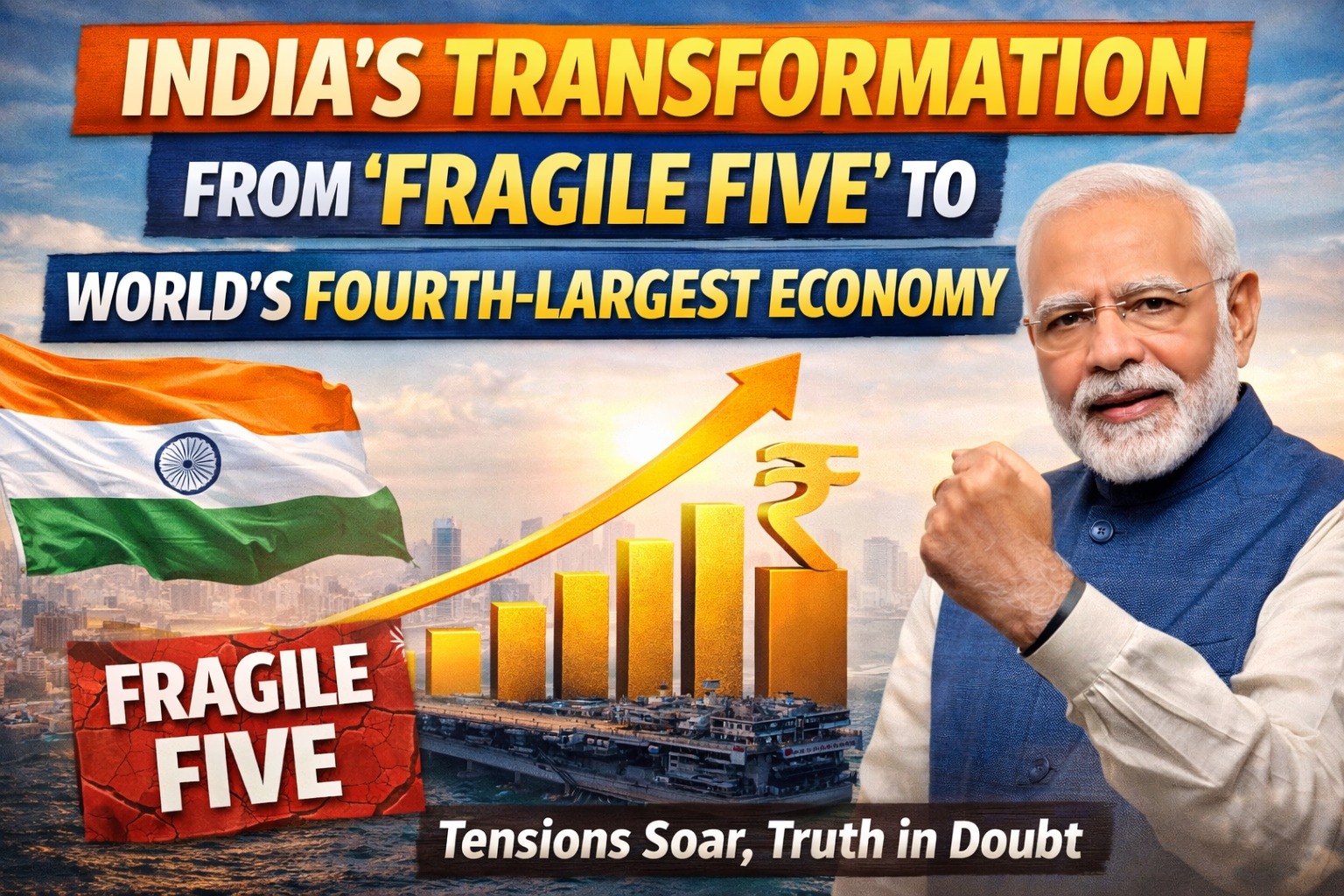
India’s Transformation from ‘Fragile Five’ to World’s Fourth-Largest Economy Signals Strong Growth Momentum
India’s economic journey from being labelled part of the “Fragile Five” a decade ago to emerging as the world’s fourth-largest economy reflects a decisive shift in global confidence and domestic capability. Fresh projections indicate that the country continues to sustain strong growth despite global headwinds.
According to estimates released by the Ministry of Statistics and Programme Implementation (MoSPI), India’s real Gross Domestic Product (GDP) is expected to expand by 7.6% in FY26, underlining robust macroeconomic fundamentals. In nominal terms — which include the impact of inflation — GDP is projected to grow by 8.6%, suggesting stable price conditions alongside rising output.
Consistent Quarterly Performance Drives Expansion
Recent quarterly data highlights the resilience of the Indian economy. Real GDP growth touched 8.4% in the second quarter and remained strong at 7.8% during the October–December period, reflecting sustained momentum across core sectors.
Over the past two financial years, India has maintained steady expansion. Real growth stood at 7.2% in 2023–24 and 7.1% in 2024–25. Nominal GDP growth during the same period registered 11.0% and 9.7%, respectively — demonstrating a balance between volume growth and price stability.
Manufacturing Leads the Charge
Manufacturing has emerged as a primary growth engine, recording double-digit expansion. The sector’s performance has been supported by policy initiatives aimed at boosting domestic production, strengthening supply chains, and encouraging foreign investment.
The broader secondary sector — including construction and utilities — has also contributed meaningfully, while the services sector continues to remain a pillar of strength, driven by finance, IT, trade, and communication services.
Strong domestic consumption, infrastructure spending, and private investment have further reinforced economic momentum.
New GDP Base Year Enhances Data Accuracy
MoSPI’s latest projections are based on a revised GDP series with 2022–23 as the new base year, replacing the earlier 2011–12 benchmark. Updating the base year is a standard statistical practice aimed at capturing structural changes in the economy more accurately.
The revision aligns India’s national accounting framework with global best practices and improves the precision of sectoral measurement, offering policymakers and investors clearer insights into economic performance.
From ‘Fragile Five’ to Global Growth Leader
A decade ago, India was grouped among the so-called “Fragile Five” economies considered vulnerable to external shocks. Today, it stands as one of the fastest-growing major economies worldwide and has climbed to become the fourth-largest economy in nominal GDP terms.
This transformation reflects improved fiscal management, a strengthened banking system, rising foreign exchange reserves, and sustained structural reforms.
Outlook: Sustained Momentum Amid Global Uncertainty
Despite global economic volatility, geopolitical tensions, and fluctuating commodity prices, India’s growth outlook remains comparatively strong. Broad-based expansion across manufacturing, services, and infrastructure suggests durable economic fundamentals.
With demographic advantages, increasing digital adoption, and expanding industrial capacity, India appears positioned to maintain its upward trajectory in the global economic landscape.
Summary
India’s projected 7.6% real GDP growth in FY26 underscores its evolution from a once-vulnerable economy to the world’s fourth-largest. Manufacturing, services, and sustained domestic demand are driving expansion, while a new GDP base year improves statistical accuracy. The data reinforces India’s standing as one of the fastest-growing major economies globally.
Disclaimer
This article is based on official statements and publicly available information. Economic projections are based on official estimates and may be subject to revisions. Growth forecasts depend on domestic and global economic conditions. The publication does not independently verify any claims or assertions mentioned in the developments.