

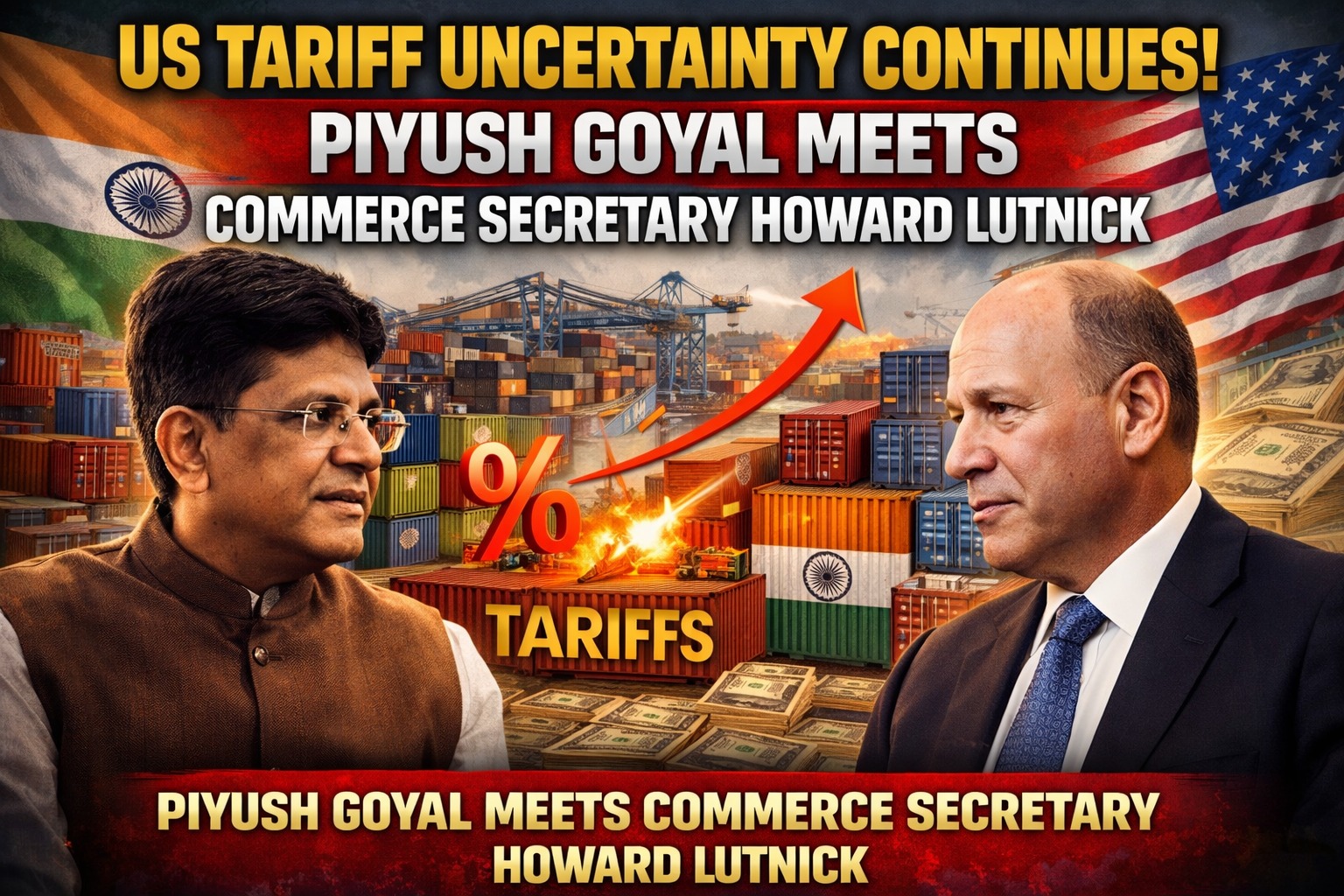
US Tariff Uncertainty Continues as Piyush Goyal Meets Commerce Secretary Howard Lutnick
Trade discussions between India and the United States remain active despite uncertainty surrounding proposed US tariff measures. Union Commerce and Industry Minister Piyush Goyal met US Commerce Secretary Howard Lutnick in New Delhi on Thursday, indicating that both governments are maintaining dialogue even as trade policy adjustments remain under review.
While official details of the closed-door discussions were not disclosed, both sides described the engagement as constructive. Goyal shared on social media that the meeting focused on expanding bilateral trade and strengthening economic cooperation. US Ambassador to India Sergio Gor also described the interaction as highly productive, highlighting multiple areas of potential collaboration between the two nations.
Lutnick’s visit marks the highest-level engagement from US President Donald Trump’s economic team in recent months. Though the US Commerce Secretary was in India for a private visit, including attendance at a wedding in Jodhpur, the meeting with Indian officials underscores Washington’s interest in preserving strategic trade communication.
Tariff Framework on Hold, But Trade Goals Intact
The discussions come at a time when a proposed interim tariff framework between the two countries remains paused. Under earlier negotiations, the United States was expected to reduce reciprocal tariffs on Indian goods to 18 percent. However, the implementation of that arrangement has been delayed following a recent ruling by the US Supreme Court that impacted the administration’s broader reciprocal tariff strategy.
Despite the uncertainty, both sides appear committed to long-term trade expansion. The United States and India have set an ambitious target of achieving $500 billion in bilateral trade, a goal jointly articulated by Prime Minister Narendra Modi and President Trump. Officials from both governments have repeatedly emphasized that economic cooperation remains a cornerstone of the strategic partnership.
Following the court ruling, India and the US mutually agreed to reschedule meetings between negotiators, including India’s chief trade negotiator Darpan Jain, to finalize the legal framework for the proposed interim arrangement.
Key Sectors Benefit from Tariff Relief
India’s export-driven industries are closely monitoring developments. The United States remains India’s largest export market, accounting for nearly 20 percent of total goods exports. Earlier tariff hikes — including a 50 percent duty in certain categories, with an additional 25 percent penalty tied to India’s crude oil purchases from Russia — had significantly impacted several labour-intensive sectors.
Recent tariff relaxations have provided relief to industries such as textiles, leather goods, seafood, carpets, and gems and jewellery. Exporters in these sectors had reported sharp declines in competitiveness due to the higher duties.
The meeting between Goyal and Lutnick signals that while policy recalibration may be underway in Washington, economic engagement with India continues to be a priority. Analysts believe maintaining open communication channels could help prevent prolonged trade disruptions and support the broader strategic relationship.
As global trade dynamics shift, both New Delhi and Washington appear focused on stabilizing their commercial ties while navigating legal and political complexities surrounding tariff policies.
Summary
Amid uncertainty over US reciprocal tariffs, Commerce Minister Piyush Goyal met US Commerce Secretary Howard Lutnick in New Delhi, reaffirming ongoing trade engagement between the two nations. Although an interim tariff reduction framework remains on hold following a US Supreme Court ruling, both countries continue to pursue their $500 billion bilateral trade target. Recent tariff relief has benefited key Indian export sectors such as textiles and gems and jewellery, while negotiations are expected to resume soon.
Disclaimer
This article is based on publicly available information, official statements, and media reports. It is intended for informational purposes only. Readers are advised to refer to official government releases and verified sources for detailed and updated information.