

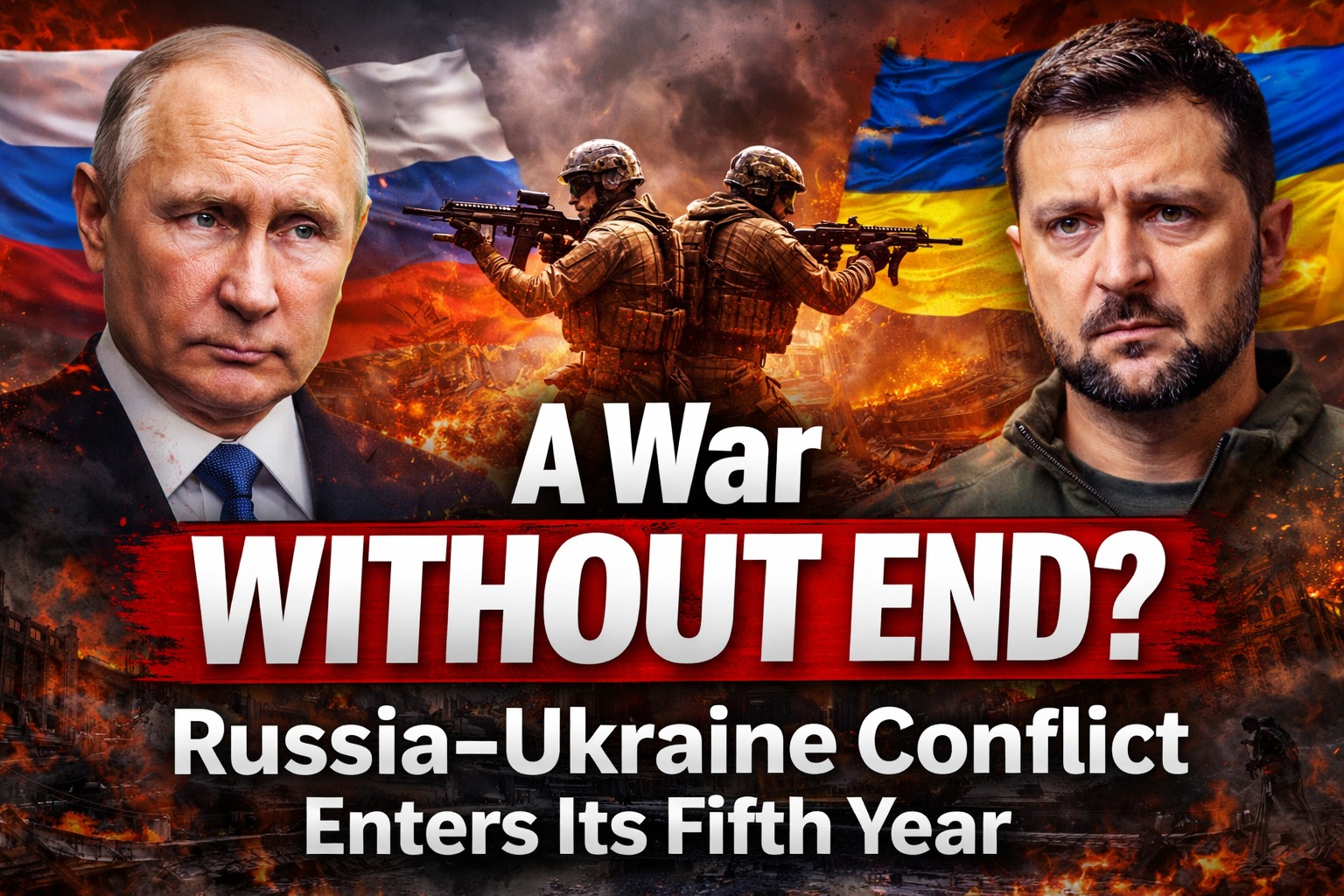
A War Without End? Russia–Ukraine Conflict Enters Its Fifth Year
On February 24, 2026, the armed conflict between the Russian Federation and Ukraine reached its fourth anniversary. What began as a rapid offensive in February 2022 has since evolved into a protracted interstate war characterized by entrenched front lines, attritional combat, and extensive international economic and diplomatic involvement. This article presents a structured, evidence-based review of the conflict’s principal dimensions: military developments, casualty estimates, global trade realignments under sanctions, and the limitations of diplomatic efforts as of early 2026.
- Introduction
The Russian Federation’s full-scale invasion of Ukraine commenced on February 24, 2022. Over four years later, hostilities continue across a broad operational front, with no lasting ceasefire or negotiated settlement. This analysis aims to provide a dispassionate examination of the conflict’s ongoing dynamics, drawing on publicly available data and widely recognized research institutions.
-
- Military Situation
2.1 Front Line and Control of Territory
The active defense and battle line of the conflict spans over 1,000 kilometers, predominantly in eastern and southern regions of Ukraine. Russian military forces control approximately 20% of internationally recognized Ukrainian territory, including:
- The Crimean Peninsula (annexed in 2014),
- Portions of Donetsk and Luhansk oblasts,
- Segments of Zaporizhzhia and Kherson oblasts seized since 2022.
Since 2025, territorial changes have occurred slowly and locally. Russian official statements indicate ongoing tactical gains near Slovyansk, Kupyansk, and eastern Zaporizhzhia. Independent observers note that advances are often incremental, measured in meters or small settlements rather than broad operational breakthroughs.
2.2 Characteristics of Warfare
The conflict has largely transitioned into a war of attrition:
- Trenches and fortified lines dominate large sections of the battlefield;
- Artillery duels, unmanned aerial systems, and electronic warfare are extensively employed;
- Both belligerents use precision-guided munitions and long-range fires to target logistics and infrastructure.
Civilians and noncombatants are frequently affected due to the proximity of military operations to populated areas, though systematic documentation varies by reporting source.
- Casualty Estimation
Accurate casualty counts remain challenging due to limited independent access and methodological divergence among reporting bodies. Current estimates include:
- Military casualties: Combined Russian and Ukrainian personnel casualties (killed, wounded, missing) are estimated between 1.8 million and nearly 2 million. A January 2026 report published by a leading research institution estimated Russian military casualties at approximately 1.2 million (including up to 325,000 fatalities), while Ukrainian military losses were placed between 500,000 and 600,000 (including 100,000–140,000 fatalities). Ratios vary by campaign phase and operational context.
- Civilian casualties: United Nations documentation records over 15,000 confirmed civilian deaths since 2022, with 2025 reportedly recording the highest annual total. Displacement figures remain in the millions, with significant infrastructure degradation throughout conflict zones.
These figures should be interpreted as estimates rather than precise counts due to information constraints.
- Economic and Trade Realignment Under Sanctions
4.1 Sanctions Impact on Trade Flows
Following the invasion, the United States, European Union, and allied states imposed multifaceted sanctions targeting Russia’s financial system, energy sector, and key export commodities. These measures aimed to constrain Russia’s fiscal capacity to sustain prolonged military operations. However, sanctions have resulted in structural trade realignments rather than cessation of economic exchange.
4.2 Energy and Commodities
- Exports to Asia: Despite sanctions, Russia has maintained or increased crude oil export volumes directed toward Asian markets, particularly China and India. Revenue dynamics reflect discounted pricing and logistical adjustments, including alternative shipping and insurance mechanisms.
- Continued U.S. imports: The United States continues limited imports of select materials essential to industrial and energy sectors, including:
- Low-enriched uranium and associated nuclear fuel products,
- Palladium and other platinum group metals,
- Fertilizer inputs.
These imports reflect structural dependencies in global supply chains rather than normalized bilateral economic relations.
- Continued European imports: Europe has substantially reduced direct imports of Russian energy, particularly pipeline gas. Nonetheless, limited flows of liquified natural gas (LNG), nuclear fuel components, industrial metals, and fertilizer feedstocks persist due to transitional infrastructure constraints and the absence of immediate alternatives.
These trade continuities underscore the complexity of achieving full economic decoupling in integrated global commodity markets.
- Diplomatic Dynamics
5.1 Multilateral Engagements
Throughout 2025 and into 2026, diplomatic engagement has continued without yielding a major comprehensive settlement. Activities have included:
- High-level visits by leaders of the European Council and European Commission to Kyiv, reaffirming institutional support for Ukraine’s sovereignty and reconstruction planning frameworks.
- United Nations Security Council briefings marking the war’s anniversary, reflecting ongoing international attention but persistent divisions among permanent members.
5.2 Negotiation Initiatives and Limitations
U.S.-facilitated discussions between Russian and Ukrainian representatives took place in venues such as Abu Dhabi and Geneva in early 2026. These talks focused on technical de-escalation measures — including humanitarian access and prisoner exchanges — but did not resolve fundamental disputes over territorial status, security arrangements, or long-term guarantees.
5.3 Evaluation of Diplomatic Strategies
From a scholarly perspective, several structural observations can be made:
- U.S. Diplomacy: Under the Trump administration, repeated expressions of willingness to broker a “rapid end to the conflict” did not advance a substantive settlement. This reflects the broader challenge of reconciling opposing core interests without enforceable incentives or credible enforcement mechanisms.
- European Coordination: European diplomatic efforts have underscored institutional support for Ukraine’s reconstruction and resilience. However, limitations persisted in formulating a unified negotiating position that could bridge Russian and Ukrainian demands, particularly regarding security guarantees and territorial governance models.
- NATO Expansion Debates: Discussions concerning NATO’s open door policy and Ukraine’s long-term security alignment have been salient in strategic analyses, though they remain political factors rather than direct proximate causes of military operations.
These patterns indicate the inherent difficulty of negotiating peace in a conflict where security perceptions, territorial control, and alliance commitments are deeply contested.
- Strategic Consequences and Outlook
As of February 24, 2026, the conflict shows no definitive sign of imminent resolution. Military attrition continues along extended front lines, trade flows have adapted to sanctions regimes, and diplomatic engagement has yet to produce a sustained framework for political settlement.
The war’s trajectory continues to influence European security architecture, global energy markets, defense postures, and alliance dynamics. Its multidimensional impacts are likely to persist into subsequent years unless fundamental shifts occur in diplomatic, economic, or operational conditions.
- References and Data Considerations
This article synthesizes data from international research institutions, United Nations reports, official military communication, and trade analytics as of early 2026. All figures are approximate and subject to revision as additional verified information becomes available.
- Summary
After four years of sustained hostilities, the Russia–Ukraine conflict remains unresolved. Battlefield dynamics continue to exhibit incremental changes rather than decisive breakthroughs. Sanctions have reshaped global trade but not eliminated strategic commodity flows. Diplomatic efforts under multiple actors, including the United States, Europe, and multilateral forums, have not yielded a comprehensive settlement. The strategic consequences of the conflict extend beyond regional borders and remain central to global security discourse.
- Disclaimer
This article is based on publicly available information and scholarly sources as of February 24, 2026. The presentation aims for objectivity and analytical balance. Given the evolving nature of ongoing conflict, data and interpretations may change as new information becomes available.