
Trump Escalates Global Tariffs to 15% After Supreme Court Setback, Triggering Fresh Trade Uncertainty
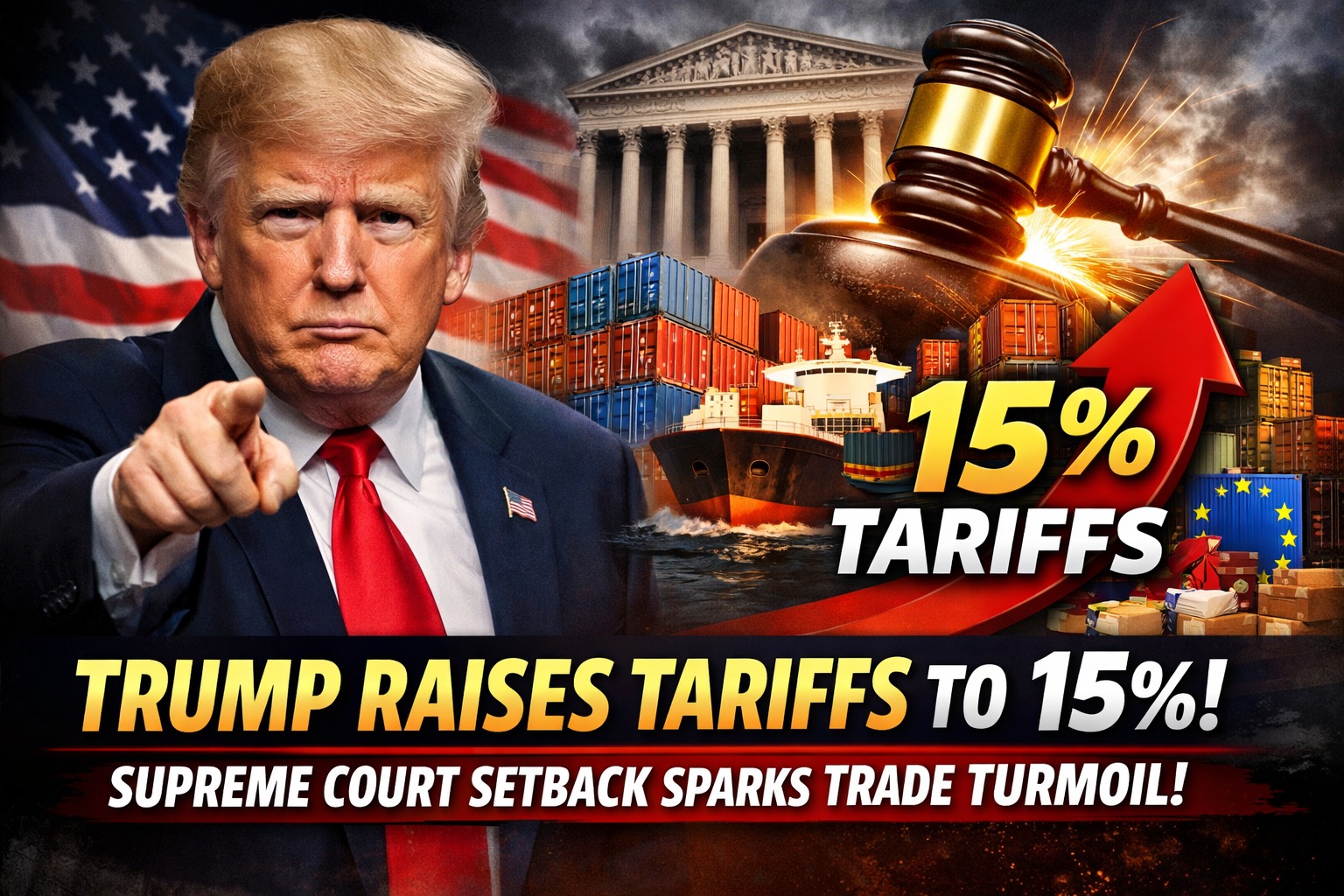
In a dramatic escalation of trade tensions, U.S. President Donald Trump has increased the global tariff rate from 10% to 15%, intensifying volatility in international markets. The decision follows a 6–3 ruling by the Supreme Court of the United States that rejected his previous approach to imposing broad-based tariffs.
Taking to his social media platform, Truth Social, Trump defended the move, stating that the new tariff level falls within the maximum limit permitted under Section 122 of the Trade Act. This provision allows the president to temporarily impose duties—up to 15% for 150 days—to address serious balance-of-payments deficits.
Court Clash and Political Fallout
The Supreme Court’s majority opinion invalidated the earlier tariff framework, prompting sharp criticism from Trump, who described the ruling as flawed and damaging to national interests. He asserted that the revised tariff rate was introduced after a comprehensive review of the Court’s judgment and emphasized that the administration would soon unveil additional trade measures aligned with its broader economic agenda.
However, the move has rattled global markets. Analysts warn that sudden shifts in tariff policy make it difficult for exporters and multinational corporations to plan production, pricing, and supply chains. Economists also point out that the United States does not run uniform trade deficits with all countries, which could complicate the legal foundation of a blanket tariff increase.
Brazil and the Politics of Tariffs
One of the most controversial examples involves Brazil. Despite the U.S. maintaining a $14 billion trade surplus with Brazil, Washington imposed a steep 50% tariff on Brazilian goods. Observers interpret the move as politically charged, particularly amid tensions surrounding Brazil’s domestic leadership under President Luiz Inácio Lula da Silva and his political rivalry with former President Jair Bolsonaro, who has enjoyed Trump’s support.
Critics argue that such measures blur the line between trade policy and geopolitical strategy, raising concerns about consistency and fairness in U.S. economic diplomacy.
What Comes After 150 Days?
Section 122 authorizes tariffs for a limited 150-day period. Trump has indicated that these temporary levies may later transition into longer-term measures under Section 301 of the Trade Act. Section 301 allows the U.S. government to impose more permanent duties if foreign trade practices are deemed unfair or discriminatory—but it requires detailed investigations, product-level analysis, and formal notification procedures by the Office of the U.S. Trade Representative.
The United States previously invoked Section 301 against India in 2020 over its Digital Services Tax (DST). Washington argued that India’s 2% levy disproportionately targeted American technology companies such as Google, Amazon, and Meta Platforms. Earlier this month, under an interim framework agreement, India agreed to phase out the tax to avoid the reimposition of retaliatory tariffs.
Growing Legal and Economic Questions
Trade experts caution that expanding tariff powers beyond traditional deficit concerns could invite further legal challenges. Since trade relationships differ significantly country by country, blanket measures may struggle to withstand judicial scrutiny.
For now, the global trading community faces renewed uncertainty. Businesses across continents must reassess supply chains, pricing strategies, and risk exposure as Washington signals a tougher, more unpredictable trade stance.
Summary
President Donald Trump has raised global tariffs from 10% to 15% under Section 122 of the Trade Act after the U.S. Supreme Court struck down his earlier tariff authority. The move is expected to heighten global trade instability and may face additional legal challenges. Trump has also indicated plans to transition to more permanent tariffs under Section 301, a measure previously used against India over its Digital Services Tax. The escalation has drawn criticism from economists and trade experts concerned about its economic and legal implications.