

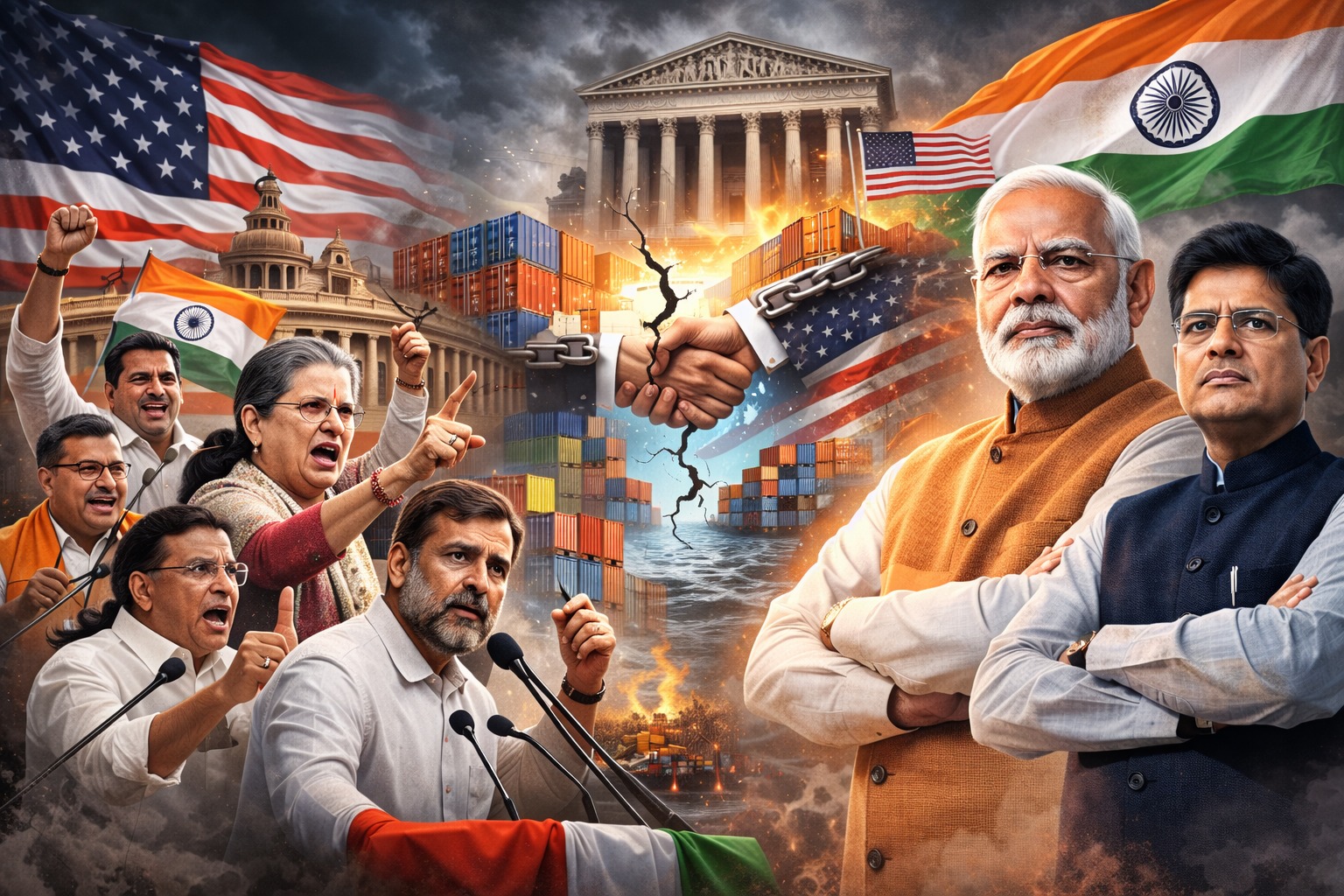
Opposition Targets Centre After US Court Curbs Trump Tariffs; Trade Deal Sparks Fresh Political Row
A fresh political confrontation has erupted in India after the Supreme Court of the United States struck down former U.S. President Donald Trump’s sweeping global tariffs. The verdict has reignited debate over India’s interim trade understanding with Washington, with senior opposition leaders questioning the timing and terms of the agreement.
Rahul Gandhi’s Sharp Attack
Leader of Opposition Rahul Gandhi accused Prime Minister Narendra Modi of being “compromised,” claiming that the court’s decision has exposed weaknesses in India’s negotiating position.
Posting on X (formerly Twitter), Gandhi alleged that the Prime Minister would be unable to renegotiate the trade terms and suggested that India had conceded too much in anticipation of tariff measures that have now been curtailed by the U.S. judiciary.
What the US Supreme Court Decided
In a 6–3 majority ruling, the Supreme Court of the United States held that the Trump administration overstepped its authority by invoking the International Emergency Economic Powers Act (IEEPA) to impose broad import tariffs. The judgment effectively limited the executive branch’s ability to use emergency powers for sweeping trade restrictions.
Reacting to the setback, Trump termed the ruling “a terrible decision” and announced plans to impose a 10% global tariff under Section 122 of the Trade Act of 1974. This provision permits temporary import surcharges—up to 15%—for 150 days to address balance-of-payments concerns.
Priyanka Chaturvedi Questions Timing of Deal
Echoing similar concerns, Priyanka Chaturvedi of the Shiv Sena (UBT) questioned why India finalized an interim trade deal without waiting for the U.S. court’s verdict.
She argued that while Indian exports now face a 10% tariff following judicial intervention, American imports continue to enter India at zero duty in several categories. In her remarks, she contrasted India’s approach with that of Brazil, praising the South American nation for defending its trade sovereignty despite being subjected to higher tariffs.
Chaturvedi described the U.S. court’s decision as a “vindication,” implying that India might have secured more favorable terms had it delayed negotiations.
Russian Oil and Strategic Autonomy Debate
In a separate post, Chaturvedi cited reports suggesting that China, despite being subject to the revised tariff framework, continues to import discounted Russian oil without facing additional constraints. She criticized the Indian government for allegedly limiting its leverage in energy procurement under the interim arrangement.
The remarks have intensified scrutiny of India’s broader trade and foreign policy calculus—particularly its balancing act between maintaining strategic autonomy and strengthening ties with Washington.
Broader Implications
The controversy underscores the interconnected nature of global trade, domestic politics, and judicial oversight. With tariff frameworks shifting and legal boundaries being redefined in the United States, India’s trade policy decisions are now facing renewed examination at home.
Whether the interim agreement proves strategically sound or politically costly may depend on how future negotiations unfold—and whether Washington moves toward longer-term tariffs under provisions such as Section 301 of the Trade Act.
Summary
After the U.S. Supreme Court ruled that the Trump administration exceeded its authority in imposing global tariffs under emergency powers, Indian opposition leaders intensified criticism of the Modi government’s interim trade deal with the U.S. Rahul Gandhi accused the Prime Minister of being “compromised,” while Priyanka Chaturvedi questioned the timing and terms of the agreement. The ruling has triggered a broader political debate over trade sovereignty, energy security, and India’s strategic positioning in global commerce.