

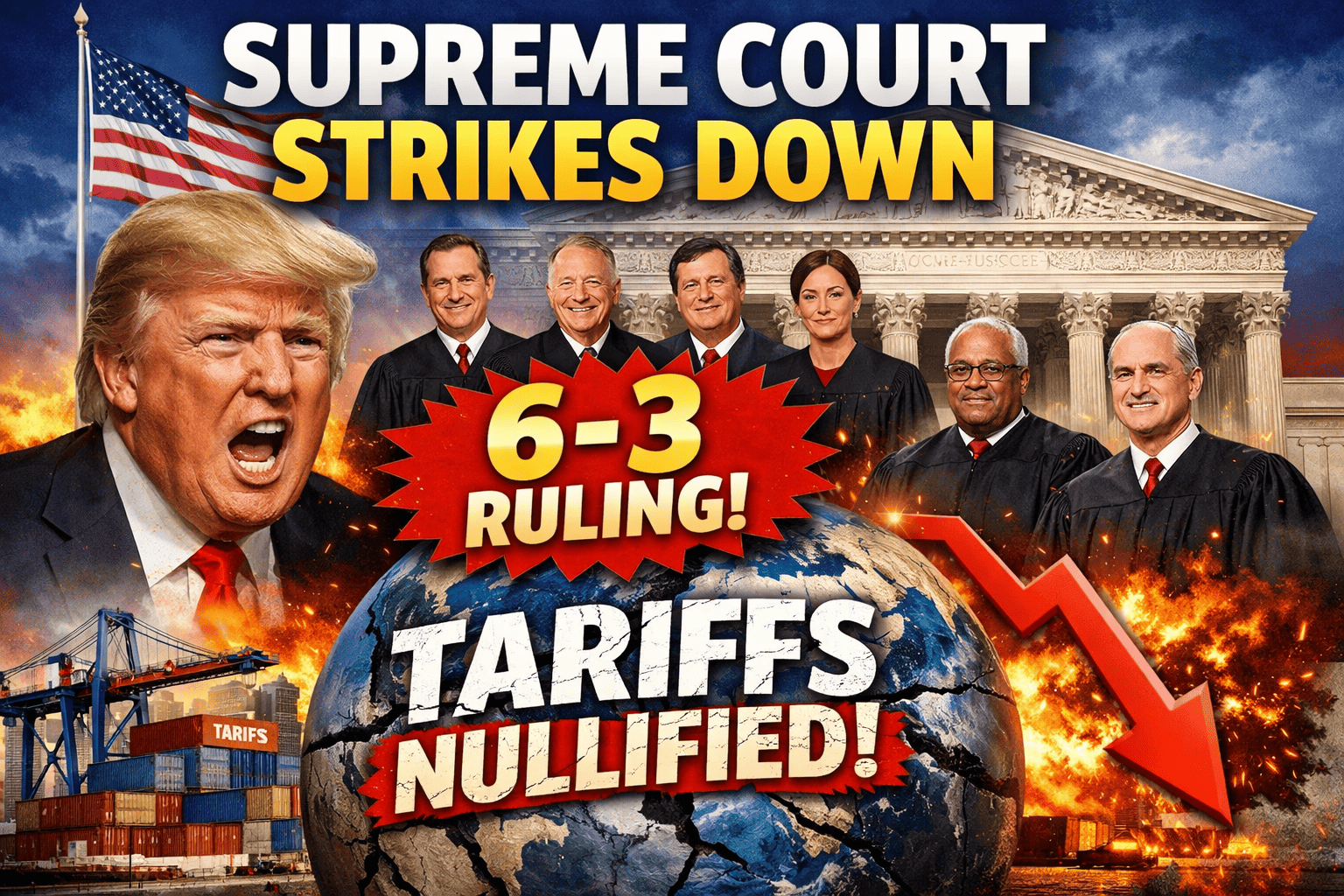
U.S. Supreme Court Nullifies Trump’s Emergency-Based Global Tariffs in Landmark 6–3 Decision
In a consequential judgment delivered on February 20, 2026, the U.S. Supreme Court invalidated a series of sweeping global tariffs imposed by President Donald Trump under emergency authority. The ruling marks a major development in the ongoing debate over executive power in trade policy and delivers a notable setback to Trump’s broader economic strategy.
The Core of the Judgment
The Court ruled 6–3 against the administration, with Chief Justice John Roberts authoring the majority opinion. At the heart of the case was the interpretation of the International Emergency Economic Powers Act (IEEPA), a 1977 statute that grants the president authority to regulate certain economic transactions during a declared national emergency involving foreign threats.
The majority concluded that while IEEPA allows the executive branch to regulate commerce under specific emergency conditions, it does not authorize the imposition of tariffs. According to the Court, tariffs constitute a form of taxation, and under Article I, Section 8 of the U.S. Constitution, the power to levy taxes rests exclusively with Congress. The justices reasoned that the phrase “regulate importation” within IEEPA does not extend to imposing duties or raising revenue, particularly since no historical precedent or prior statutory interpretation had treated it as such.
Tariffs Affected by the Ruling
The decision specifically invalidates the broad emergency-based tariffs implemented under IEEPA. These included:
- Tariffs linked to national emergency declarations concerning the influx of illegal drugs, such as 25% duties on most imports from Canada and Mexico and 10% on Chinese imports.
- So-called “reciprocal” or trade-deficit tariffs applied across the globe, often set at a baseline of 10% on imports from nearly all trading partners. These rates were frequently revised and, in some instances, labeled by the administration as “Liberation Day” tariffs.
Importantly, the ruling does not dismantle all tariffs enacted during Trump’s presidency. Measures introduced under other legal frameworks—such as Section 232 of the Trade Expansion Act (national security grounds) and Section 301 of the Trade Act of 1974 (unfair trade practices)—remain intact.
Legal Origins of the Case
The case arose from lawsuits filed by small businesses and several states that argued the emergency tariffs exceeded presidential authority and imposed significant financial burdens. One of the leading cases was brought by Learning Resources, Inc., and the matter was eventually consolidated before the Supreme Court.
While the Court invalidated the tariffs moving forward, it did not directly rule on the issue of refunds for duties already collected. Estimates suggest that between $160 billion and over $200 billion had been gathered under the emergency tariff framework. The justices remanded certain aspects of the matter to lower courts, including the U.S. Court of International Trade, to determine how refund claims should be handled. The potential reimbursement process could involve billions of dollars, though questions remain about how much of those costs were ultimately passed on to consumers.
Presidential Response
President Trump responded forcefully within hours of the ruling. At a White House press conference, he sharply criticized the majority opinion and the justices who supported it, characterizing the decision as deeply flawed and harmful to national interests. He described the judgment as a serious setback to his trade policy objectives.
In a swift countermeasure, the president announced and signed a new across-the-board 10% global tariff, reportedly invoking authority under the Trade Act of 1974. This statute provides mechanisms for imposing tariffs in response to trade imbalances or other economic concerns. According to administration statements, the new levy is intended to replace or supplement the now-invalidated emergency tariffs. However, legal analysts anticipate that this action could also face judicial scrutiny.
Some reports suggest that the newly announced tariff may be temporary or structured at lower levels than previously imposed rates for certain nations. Nonetheless, the development introduces renewed uncertainty into global trade dynamics.
Broader Implications
The Supreme Court’s ruling reinforces congressional authority over taxation and signals limits on the president’s ability to use emergency statutes to enact broad economic measures. Many economists and legal scholars view the judgment as a significant clarification of the separation of powers in trade policy.
Supporters of the decision argue that it protects constitutional boundaries and offers potential relief to businesses and importers who bore the financial impact of the tariffs. Critics, including the dissenting justices—Thomas, Alito, and Kavanaugh—warned that the decision could lead to administrative complications, particularly concerning refunds and ongoing trade negotiations.
Markets and international trading partners have been closely monitoring the fallout, as the judgment may reshape U.S. trade strategy moving forward.
Summary
On February 20, 2026, the U.S. Supreme Court struck down President Donald Trump’s emergency-based global tariffs in a 6–3 ruling, holding that the International Emergency Economic Powers Act does not grant authority to impose tariffs, as taxation powers belong to Congress. While other Trump-era tariffs remain unaffected, the decision invalidates sweeping duties imposed under declared national emergencies. The Court left the question of refunds to lower courts. In response, President Trump announced a new 10% global tariff under a different statute, potentially setting the stage for further legal challenges. The ruling significantly reshapes the boundaries of executive power in U.S. trade policy.