

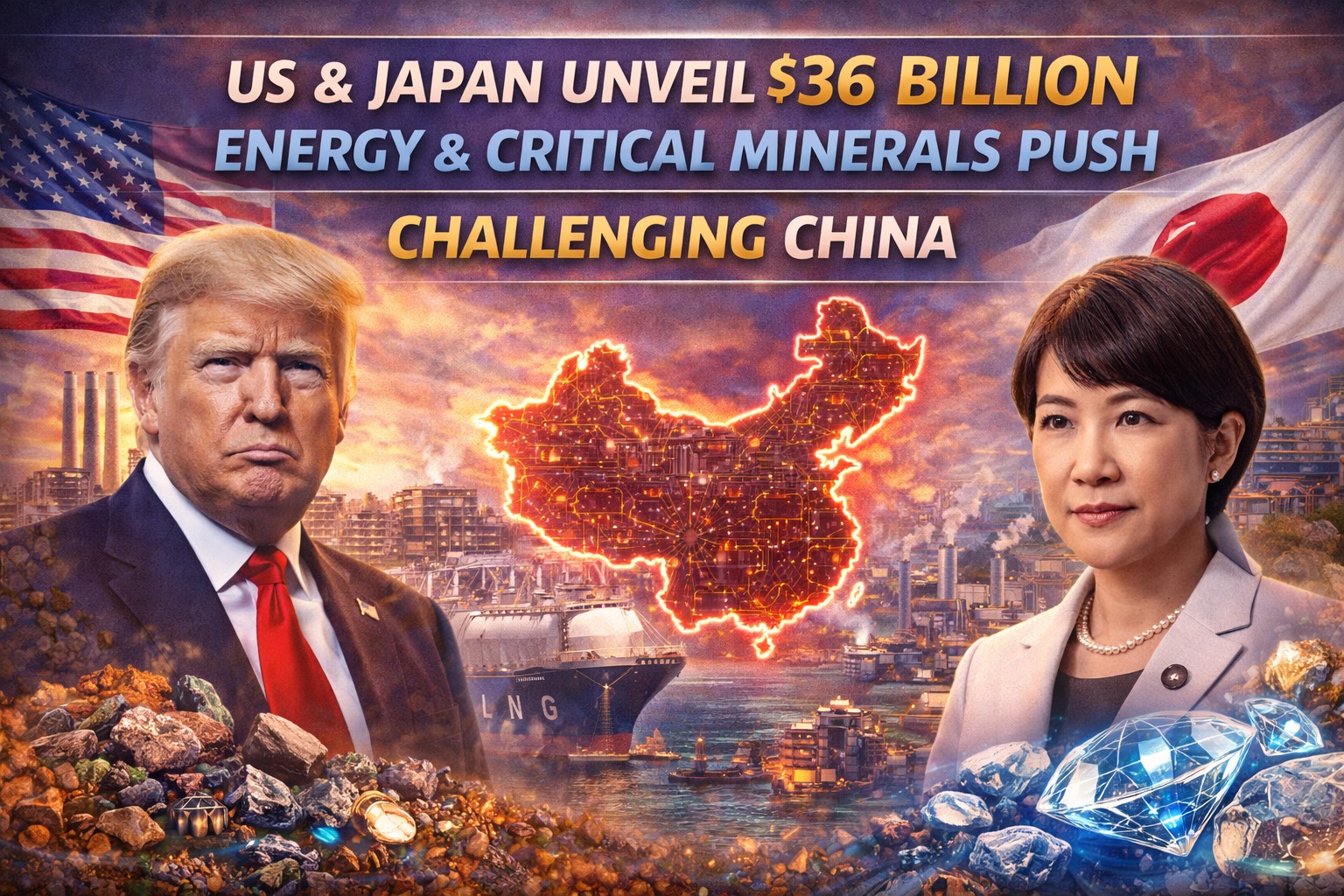
US–Japan Launch $36 Billion Energy and Minerals Push to Strengthen Strategic Supply Chains
The United States and Japan have unveiled a sweeping $36 billion package of investments in oil, gas, and critical minerals projects, marking the first phase of a broader economic partnership aimed at reinforcing supply chain security and reducing strategic vulnerabilities. The announcement was made jointly by U.S. President Donald Trump and Japanese Prime Minister Sanae Takaichi, underscoring deepening cooperation between the two nations at a time of heightened geopolitical tensions in the Indo-Pacific.
The initial tranche of projects includes three major undertakings across the United States. Among them is a massive natural gas-fired power plant in Portsmouth, Ohio, described by the Trump administration as the largest facility of its kind in U.S. history. The plant is expected to generate approximately 9.2 gigawatts of electricity annually and will be operated by SB Energy, a subsidiary of Japan’s SoftBank Group. Officials say the project will significantly bolster domestic energy production while supporting industrial growth and grid reliability.
In addition to the Ohio facility, Japan will finance the development of a deepwater crude oil export terminal off the Texas coast. The infrastructure is designed to enhance U.S. energy export capabilities, reinforcing America’s position as a global energy supplier. A third major investment involves the establishment of a synthetic industrial diamond manufacturing plant in Georgia, valued at roughly $600 million. The facility will focus on producing synthetic diamond grit, a critical material widely used in advanced manufacturing, semiconductor fabrication, and precision engineering.
The $36 billion commitment represents the first installment of a much larger $550 billion investment pledge made by Japan under a trade agreement concluded last year. In return for the investment framework, the United States agreed to lower tariffs on selected Japanese exports, including automobiles. President Trump highlighted tariffs as a driving force behind the deal, arguing that trade policy tools were instrumental in securing large-scale foreign investment into American infrastructure and manufacturing.
The strategic dimension of the partnership is equally significant. Although neither leader explicitly framed the initiative as a countermeasure, the investments come amid ongoing concerns in Washington and Tokyo about supply chain dependence on China, particularly in the area of critical minerals. China currently dominates the global mining and processing of rare earth elements, which are essential inputs in industries ranging from electronics and renewable energy to defense and automotive manufacturing. Beijing has previously restricted exports of rare earth materials, using its market leverage during trade disputes.
Japan, too, has faced pressure in recent months as diplomatic tensions with China have escalated over Taiwan’s security. Prime Minister Takaichi emphasized that the new investments would enhance economic security and strengthen bilateral ties with the United States. While she refrained from directly referencing Beijing, the context of the announcement reflects a broader strategic realignment focused on resilient and diversified supply chains.
U.S. Commerce Secretary Howard Lutnick described the industrial diamond facility as a step toward full domestic production of a material critical to advanced industries. He noted that Japanese capital would finance the projects while American infrastructure and industrial capacity would be expanded, creating strategic assets within the United States. The structure of the investments allows Japan to earn financial returns while helping the U.S. secure long-term energy and manufacturing independence.
Meanwhile, Japan’s trade performance remains robust despite geopolitical headwinds. Government data released this week showed exports rising nearly 17 percent in January, driven in part by increased shipments to China. The figures highlight the complex economic interdependence between regional powers even as strategic competition intensifies.
Overall, the $36 billion initiative signals a deepening economic alliance between Washington and Tokyo, blending trade policy, industrial expansion, and geopolitical strategy. By channeling capital into energy infrastructure and critical material production, both nations aim to reinforce economic resilience, strengthen bilateral ties, and position themselves more securely in an increasingly competitive global landscape.
Summary:
The United States and Japan have announced $36 billion in energy and critical mineral investments as part of a broader $550 billion trade-linked commitment. The projects include a major natural gas plant in Ohio, a Texas crude export facility, and a synthetic diamond manufacturing site in Georgia. The initiative aims to strengthen supply chains, reduce dependence on China, and enhance economic security for both nations.